Rare 1877 Nickel Errors (List & Pictures)
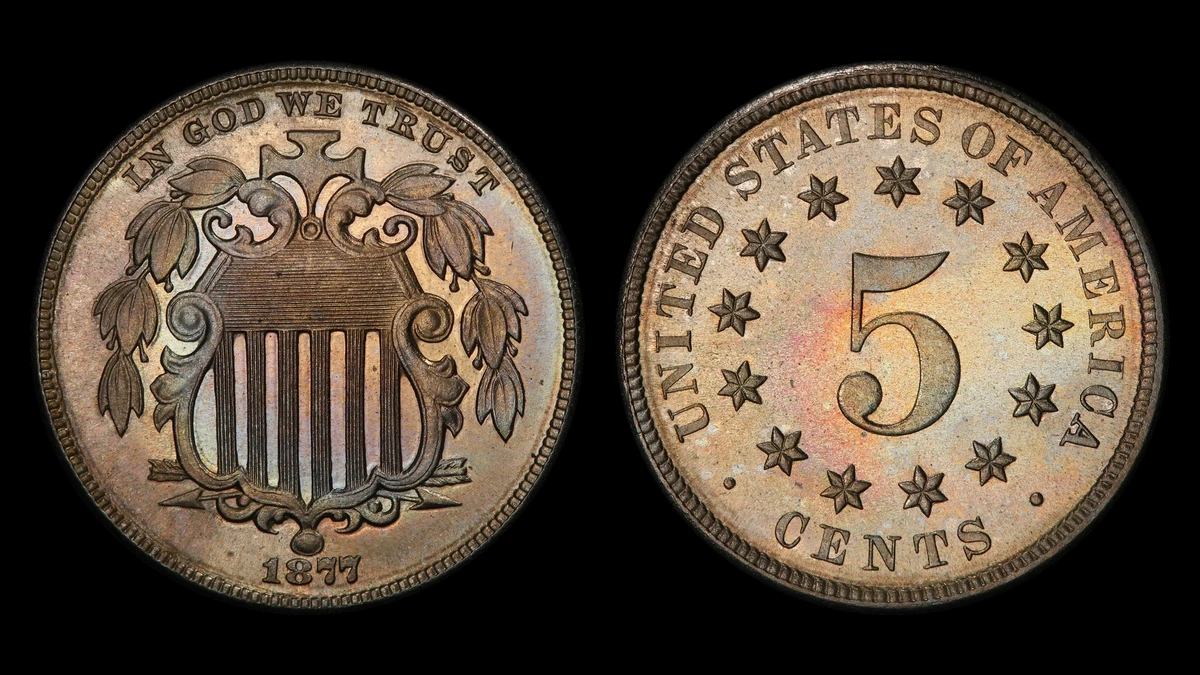
Proof identity comes first when assessing 1877 Shield Nickel errors: this is a Proof-only date, even when a coin lacks crisp detail or strong reflection. Estimated whole-coin values for the situations below span $700–$10,000.
A normal NGC PR65 Proof sold for $2,300 in September 2002, providing ordinary-coin context rather than a double-strike result. Compare original weak detail with actual overlapping reverse impressions before choosing either range.
1877 Nickel Soft Detail on a Collector Coin: Incomplete Proof Strike Error
Proof manufacture does not guarantee that every detail formed sharply. Some 1877 Shield nickels have less reflective fields and less sharply squared edges than collectors might expect.
NGC’s grading guide discusses incomplete strikes among 1877 and 1878 Proofs. That quality problem supplies neither a fixed missing feature nor a specific weak area for every 1877 coin.
The distinction is between detail that never fully formed and detail lost later. Wear and cleaning can also make a Proof appear soft or dull.
How to Identify
Confirm the full date, Shield front, and reverse stars surrounding 5 without rays between them. A weak-looking 1877 coin does not become an ordinary circulation issue because its finish is disappointing.
Compare the soft area with exposed high points where circulation normally removes detail first. Look for cleaning lines or damaged surfaces that may explain lost sharpness.
A normal loose example is about 5 grams and 20.5 millimeters. Keep a certified coin in its holder and use recorded information instead of opening it for measurements.
Dull fields or rounded rims alone cannot prove an incomplete strike. The surface must support original weakness rather than later rubbing, scraping, or polishing.
What It’s Worth
Genuine 1877 Proofs with incomplete detail are estimated at $700–$3,000 across worn, impaired, and moderately preserved examples. This prices the scarce-date coin rather than adding a surcharge for weakness.
A PR64 in Heritage’s August 2024 sale has a reported $2,200 result as a sharper comparison. That published amount is not established here as a total including fees.
Attractive original surfaces can support more interest, while cleaning, corrosion, and circulation reduce the usefulness of a higher-grade comparison. Making the coin brighter would not restore its original strike.
1877 Nickel Two Slightly Turned Designs Share the Reverse: In-Collar Double Strike Error
The documented error has two reverse impressions with a small turn between them. The reverse die moved between strikes while the coin remained within the collar.
The collar is the ring that controls the edge, so the coin can retain an ordinary round outline. No large unused crescent is required for this repeated strike.
Heritage cataloged the specimen as NGC PR65, and Mint Error News pictured it in a 2016 Central States auction preview. That high Proof grade describes preservation rather than the amount of movement.
How to Identify
Follow the large 5, stars, and reverse lettering for two corresponding design positions. Several repeated features showing the same slight turn provide stronger evidence than one thick letter.
Compare the entire reverse with the published auction preview. The relevant movement appears between impressions on that face.
A reverse that merely finishes crooked after a top-to-bottom flip raises a different alignment question. Here, two visible reverse impressions establish another blow rather than a single design tilted relative to the front.
What It’s Worth
An authenticated example comparable to the documented PR65 coin is estimated at $3,500–$10,000. No realized amount from the 2016 preview is assigned here.
The ordinary PR65 result of $2,300 shows the value already present in an attractive 1877 Proof. A clear shifted second impression adds a separate collecting feature, with original surfaces and visible separation strengthening the comparison.
Conclusion
A soft 1877 Shield nickel can remain a genuine Proof, and its weakness does not automatically earn an error premium. A double strike needs visible evidence of another impression, such as the slightly turned reverse designs on the documented coin.
Keep ordinary Proof sales separate from error estimates and preserve the original surfaces. The comparison is strongest when it explains both how the coin was made and what happened to its detail afterward.