Rare 2003 Dime Errors (List & Pictures)
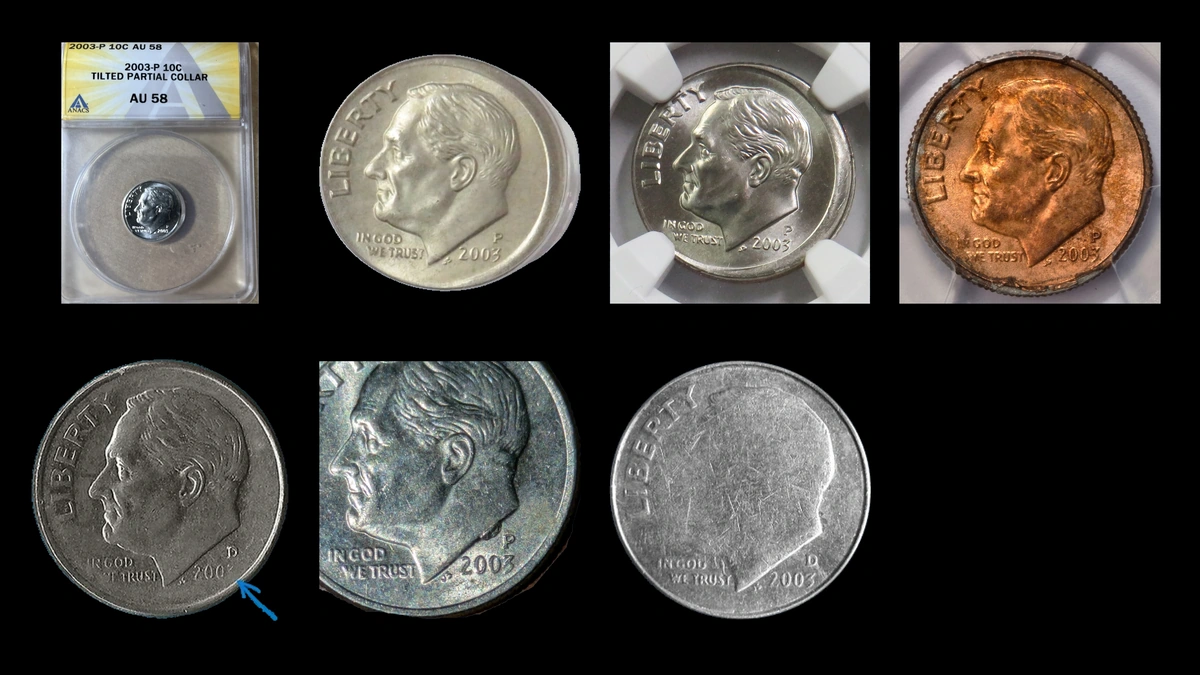
Before calling a lopsided dime off center, check whether any design is actually missing. The 2003 dime errors here span estimated values of $5–$8,500, from modest collar problems to unusual cent-stock metal.
A football-shaped Philadelphia example sold for $172.50 in February 2005. Inspect the edge and outline first, then compare the metal and altered design with the specific examples below.
| Visible difference | What it may indicate | Estimated value |
|---|---|---|
| Two edge levels | Partial collar | $5–$75 |
| Uneven wide border, complete design | Uncentered broadstrike | $10–$400 |
| Football-like outline | Elliptical incomplete blank | $100–$500 |
| Raised reverse center and hollow front | Reported die collapse combination | $300–$1,500 |
A normal clad dime weighs 2.268 grams and measures 17.91 millimeters across. Both clad and 90% silver S Proofs were made in 2003; the silver collector version normally weighs 2.50 grams.
1. 2003 Dime A Step Along the Edge: Partial Collar Error
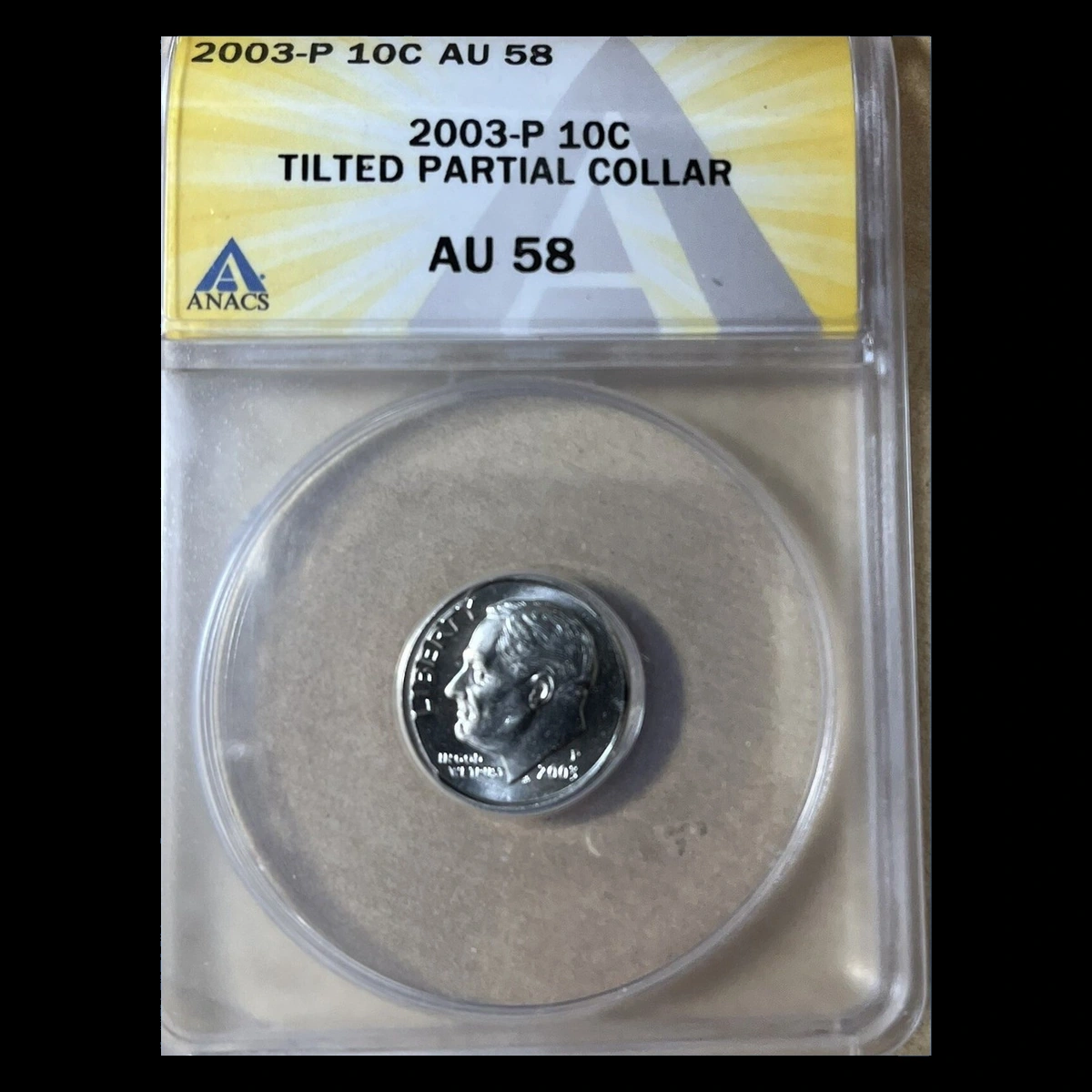
Look at the edge from the side for a narrow grooved level beside a wider level. The collar ring contained only part of the blank’s thickness, allowing the unsupported portion to spread.
This stepped appearance is often called a railroad rim. It concerns the edge itself, not merely a doubled-looking circle on the face.
How to Identify
Follow the transition between grooved and expanded metal around the circumference. It need not extend evenly all the way around.
A rolled, battered edge may have crushed grooves without an original collar step. Record weight and width on a loose coin when needed, but let the intact edge structure guide identification.
What It’s Worth
Ordinary examples suggest an estimated $5–$75. A distinct undamaged step makes a stronger comparison than slight border unevenness.
Fred Weinberg’s January 2007 list offered a 2003-P partial-collar dime for $5. That historical dealer request is not an auction result.
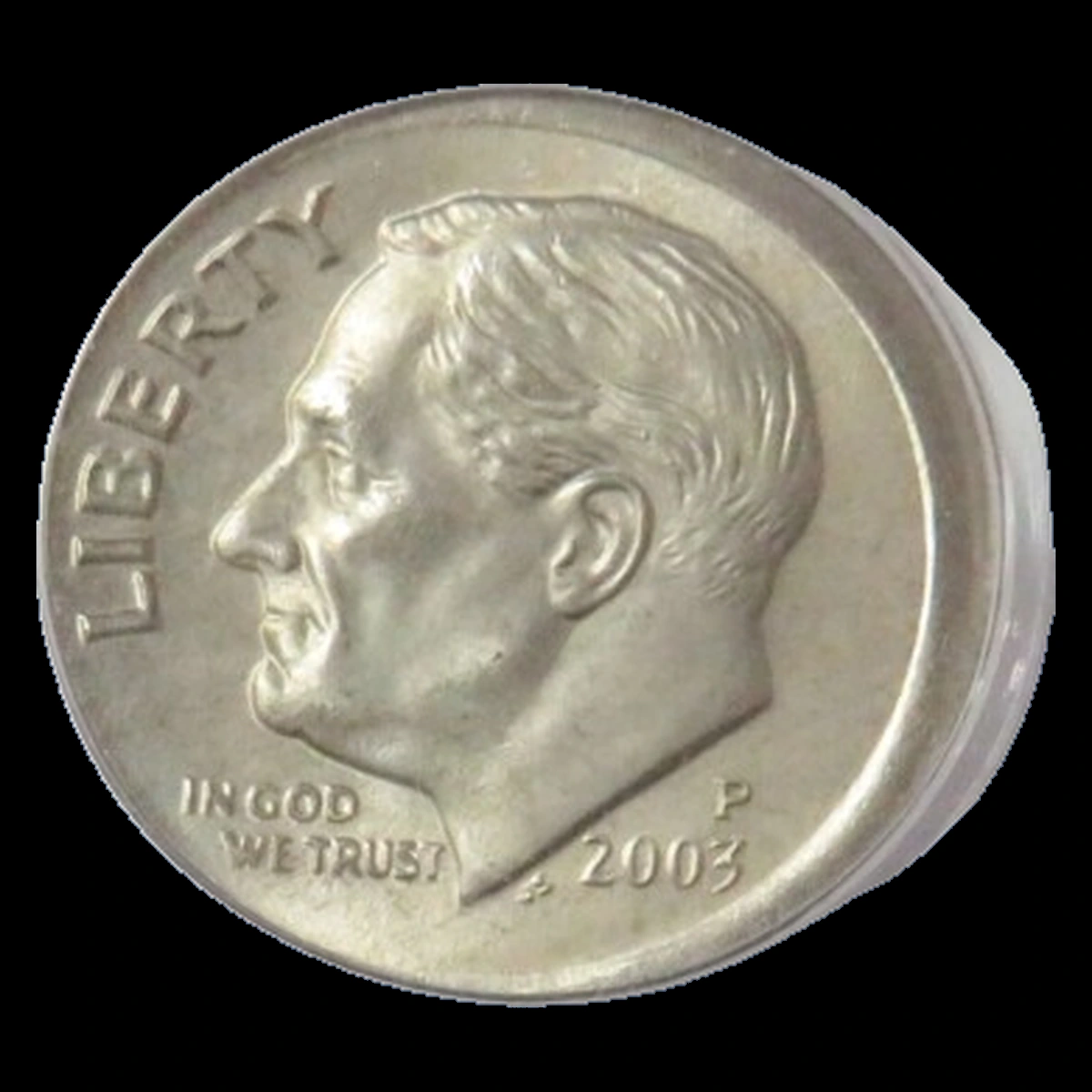
2. 2003 Dime A Wide Border but No Missing Design: Broadstrike Error
A dime can spread unevenly when the collar fails to contain it. If the complete design remains, the uneven result can be an uncentered broadstrike.
Weinberg specifically described 2003 coins with this appearance. A broad border on one side therefore does not automatically mean the blank was struck off center.
How to Identify
Read the lettering near the narrowest border on both faces. Complete original design beside expanded metal supports broadstriking.
Inspect the edge for natural flow and compare unequal widths. A vise-flattened coin may instead have crushed letters, rubbed high points, and a damaged rounded edge.
What It’s Worth
The estimated span is $10–$400, with slight spreading usually near the modest end. More dramatic expansion needs an equally clear actual specimen.
The historical Weinberg price list offered a Philadelphia uncentered broadstrike for $12 and a Denver example for $15. These were asking prices for ordinary unworn examples.
3. 2003 Dime Design Runs Beyond the Blank: Off-Center Strike Error
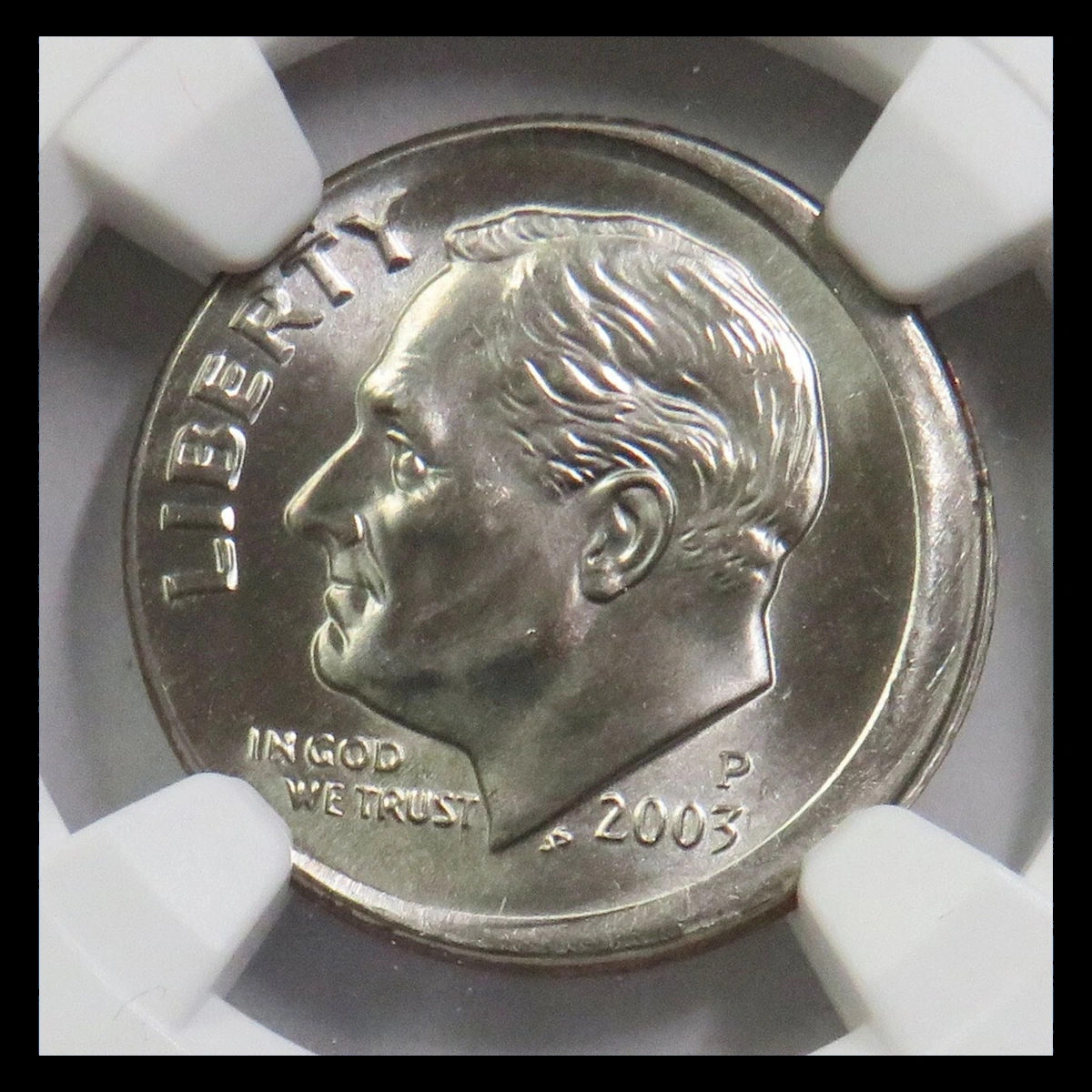
Unlike a broadstrike, an off-center strike loses part of the intended design. An untouched crescent remains where the blank lay outside the dies.
GreatCollections offered a 2003-P example graded ICG MS65 in 2011. The supplied listing does not state its shift percentage or direction.
How to Identify
Compare both faces for corresponding displacement and an original unstruck region. Check that the region was not ground smooth after striking.
Keep the date and mintmark visible in photographs. A different listing’s percentage cannot supply the missing measurement for this specimen.
What It’s Worth
A broad estimate of $10–$500 allows for differences in offset, readable date, and condition.
PCGS’s auction index records $14 for the ICG MS65 piece sold in July 2011, whose identity appears in the original GreatCollections listing. It is separate from a high-priced 15% example claimed in the year guide.
4. 2003 Dime A Football Shape or Ragged Gap: Incomplete Planchet Error
The Philadelphia elliptical coin preserves its date but loses much of ONE DIME beyond the remaining metal. Heritage described a 10% elliptical clip extending around the front from roughly 9:30 to three o’clock.
A Denver ragged clip is reported separately. Both involve missing blank metal, although one outline is football-like and the other has an irregular edge.
How to Identify
Inspect the boundary for original struck metal rather than sawing, shearing, or filing. Photograph the whole outline so lost design and missing blank material can be compared together.
The Philadelphia coin’s 10% describes its clip, not an off-center percentage. Its measured weight is not supplied and should not be invented from that figure.
What It’s Worth
Comparable elliptical pieces suggest $100–$500; ragged clips have a broader estimated span of $30–$1,000 depending on size and condition.
The PCGS MS66 elliptical specimen sold for $172.50 at Heritage in February 2005. The guide’s separate $985 Denver ragged-clip claim is not another sale of this coin.
5. 2003 Dime Copper Exposed Beneath an Outer Layer: Missing Cladding Error
A clad dime has two pale copper-nickel layers around its copper core. A missing portion of an outer layer can expose a copper-colored area on a face.
The supplied Denver seller description concerns missing portions, not necessarily an entire bare side. How the remaining layer meets the exposed area matters more than color alone.
How to Identify
Look for an actual layer boundary and preserved struck surfaces. A stain need not remove metal, while chemical stripping or grinding can expose copper after minting.
Record a precise weight and examine the edge as supporting evidence. The normal silver S Proof is a separate issue and does not represent missing cladding.
What It’s Worth
Smaller genuine missing portions suggest $50–$200, while large attractive missing-layer examples may fall around $250–$1,000.
No confirmed transaction is supplied for the Denver listing. A larger copper patch does not justify a larger premium until its mint origin is established.
6. 2003 Dime Copper Color from the Wrong Stock: Cent-Stock Planchet Error
A 2003-P PCGS MS64 Red dime was advertised as struck on cent stock. The wording identifies the intended source material, not necessarily a full cent-sized blank.
The supplied advertisement does not give measured weight or precise metal structure. Red describes preserved copper color, while MS64 describes an unworn coin with some marks.
How to Identify
Read the exact certification and document the coin’s dimensions. Do not assign the weight or diameter of an ordinary cent blank unless that identity is supported.
Metal examination must distinguish wrong stock from plating or missing dime cladding. A Lincoln design struck over a finished dime would also be a different object.
What It’s Worth
A working estimate is $3,000–$8,500 for a correctly identified example with comparable preservation.
Weinberg’s advertisement in Mint Error News asks $8,500 for the PCGS MS64 Red piece. It records an offer, not a completed auction sale.
7. 2003 Dime The Metal Opens Along a Seam: Split Planchet Error
A weak internal bond can open before or after striking and expose an inner surface. The 2003-P report does not give enough detail to settle that sequence or the exact extent of separation.
An attached split may retain all the original metal and remain near normal weight. It also differs from the loss of just one outer clad layer.
How to Identify
Inspect the opening without pulling the metal apart. Check whether the exposed surface is rough interior metal, carries struck detail, or has marks of later grinding.
Those relationships help determine the timing of the separation. An open seam does not prove a missing fragment or a surviving matching pair.
What It’s Worth
Clear partial splits suggest $100–$500, while a more complete attractive separation may reach $500–$1,500.
The guide reports $1,480 for a 2003-P MS66 specimen without clearly describing its split surfaces. Treat that as a secondary report, not a fully documented comparison for every split coin.
8. 2003 Dime An Unusual Surface After Heating: Improper Annealing Error
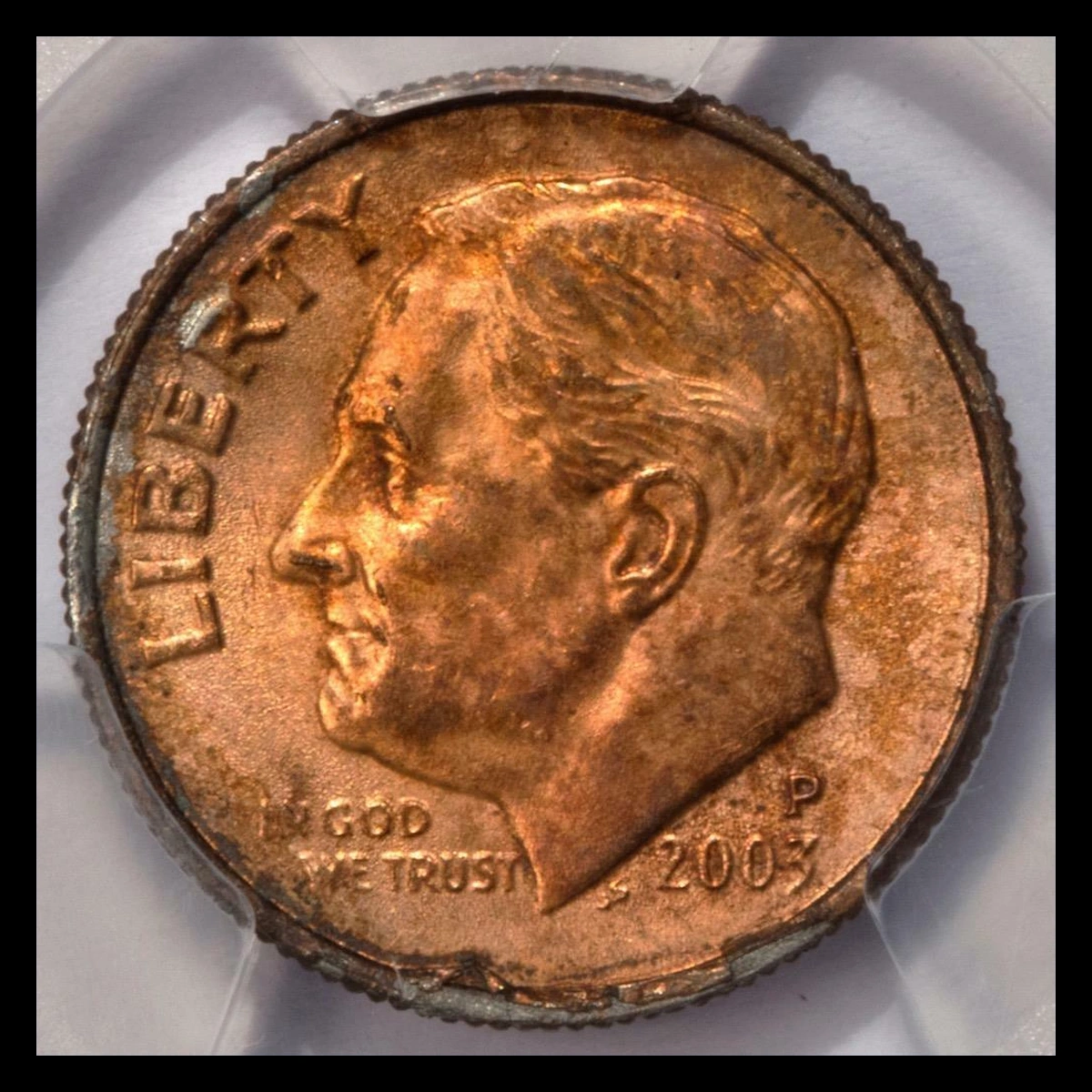
Annealing heats blanks to prepare them for striking. The year guide includes improper annealing without identifying a specific mint or measured 2003 specimen.
Unusual color or weak detail can prompt that diagnosis, but neither feature proves it. Later heating, environmental staining, and low striking pressure can produce confusing appearances.
How to Identify
Examine both faces under neutral light for pits, coatings, and rubbed surfaces. Compare shallow original detail with ordinary circulation wear.
The surface and strike must support a heating problem during manufacture. Do not heat or clean the coin to test a suspected annealing error.
What It’s Worth
Identified mint annealing errors have an estimated range of $40–$300. Strong original appearances in good condition make better comparisons.
No named 2003 auction result accompanies the report. Staining or general softness by itself does not qualify a coin for this range.
9. 2003 Dime One Patch of Design Is Absent: Struck Through Material Error
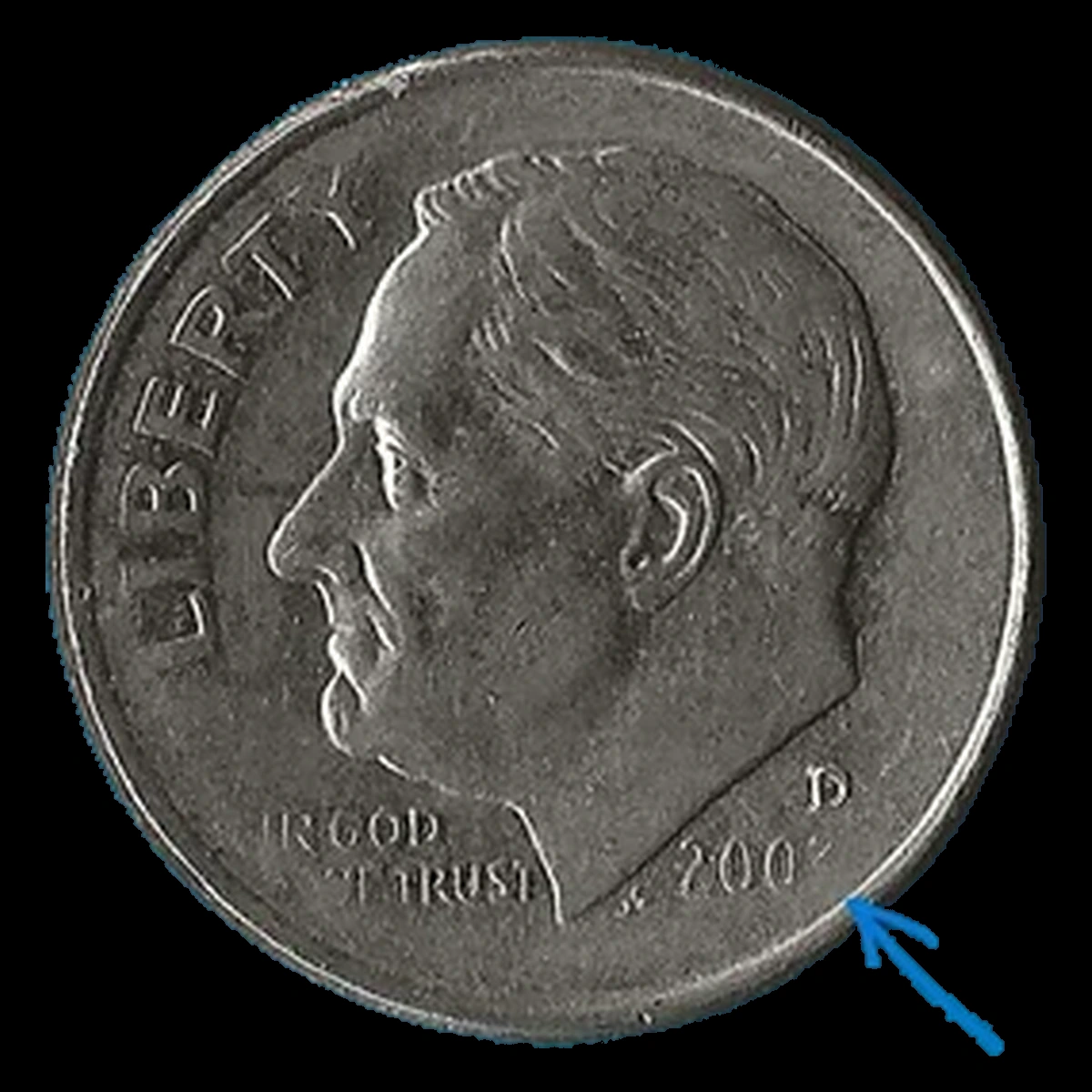
Material between a blank and a die can prevent part of the design from forming. The Denver report describes a grease-related example without establishing a particular affected location.
A filled die recess can leave weak letters beside sharper detail. An empty impression does not establish that any material remains attached.
How to Identify
Compare the weak region with nearby crisp features under the same lighting. General weakness across both sides may require an overall strike explanation instead.
Check for abrasive lines, scraped letters, and cut boundaries that could indicate later removal. Do not identify an unseen obstruction more precisely than the evidence allows.
What It’s Worth
Small affected areas suggest $10–$50, with larger clear impressions around $75–$350. Exceptional confirmed examples may be compared within $350–$1,100.
The upper range draws on a secondary guide report of $1,075 for a Denver coin. Its limited description does not support applying that figure to one faint letter on a worn dime.
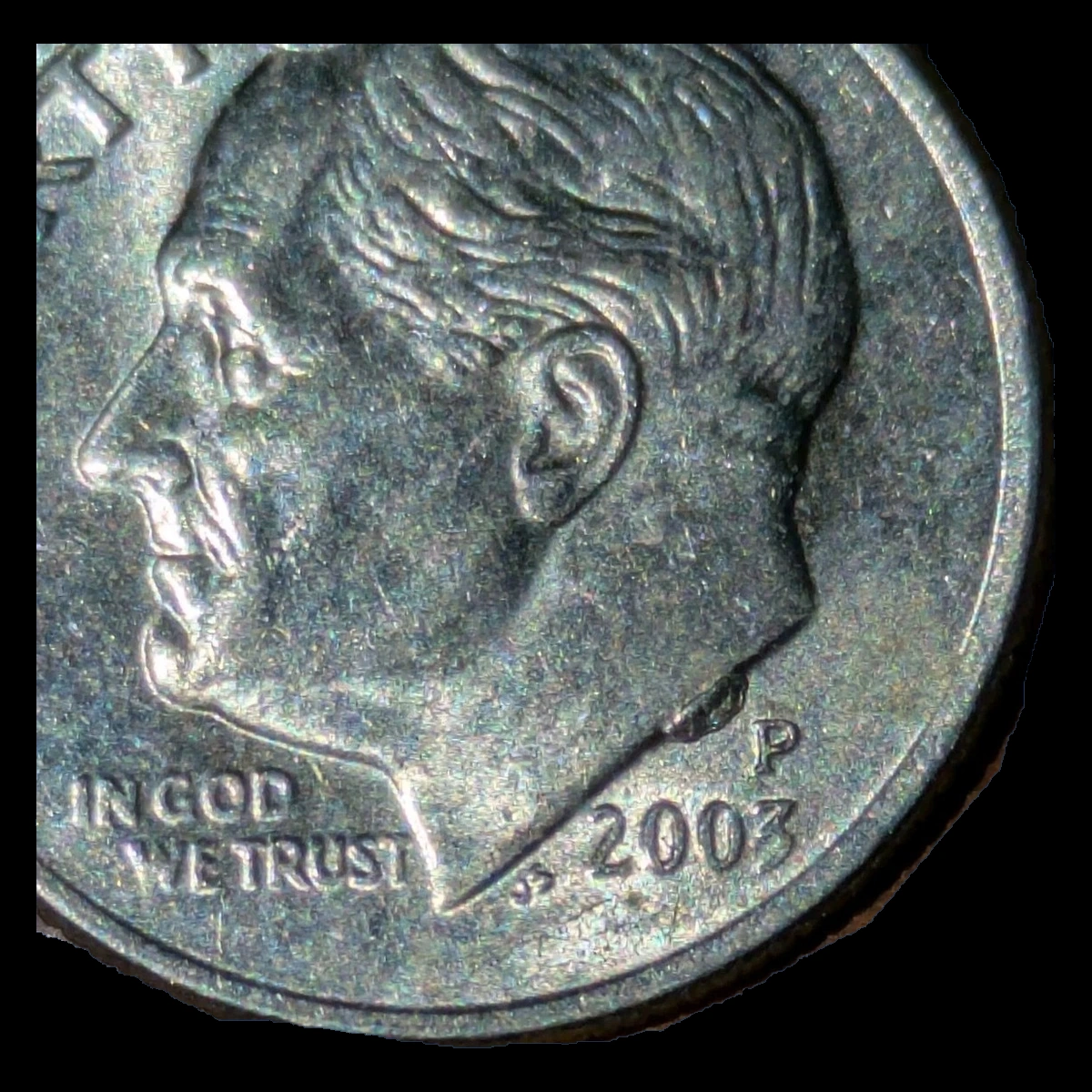
10. 2003 Dime A Raised Ridge or Spot: Die Cracks and Chips Error
A reported Denver crack runs from the rim toward Roosevelt’s head. Separate examples have small raised chips whose positions can differ.
These features copy openings in the die, the steel stamping tool. The lump is coin metal pushed into missing steel, not loose steel piled onto the coin.
How to Identify
Trace a ridge under side lighting to distinguish it from a scratch and its displaced edges. A chip should join the original surface without the boundary of an attached substance.
Use a matching 2003 pattern when comparing a filled letter or portrait lump. A generic chip photograph from another coin does not identify the candidate.
What It’s Worth
Most small chips and visible cracks fit an estimated $5–$150 range; unusually strong examples may reach $150–$250.
These are guide-based estimates without a named auctioned chip. Several tiny bumps still belong to one coin and do not receive separate full values.
11. 2003 Dime A Bulging Reverse and Hollow Front: Die Collapse Combination Error
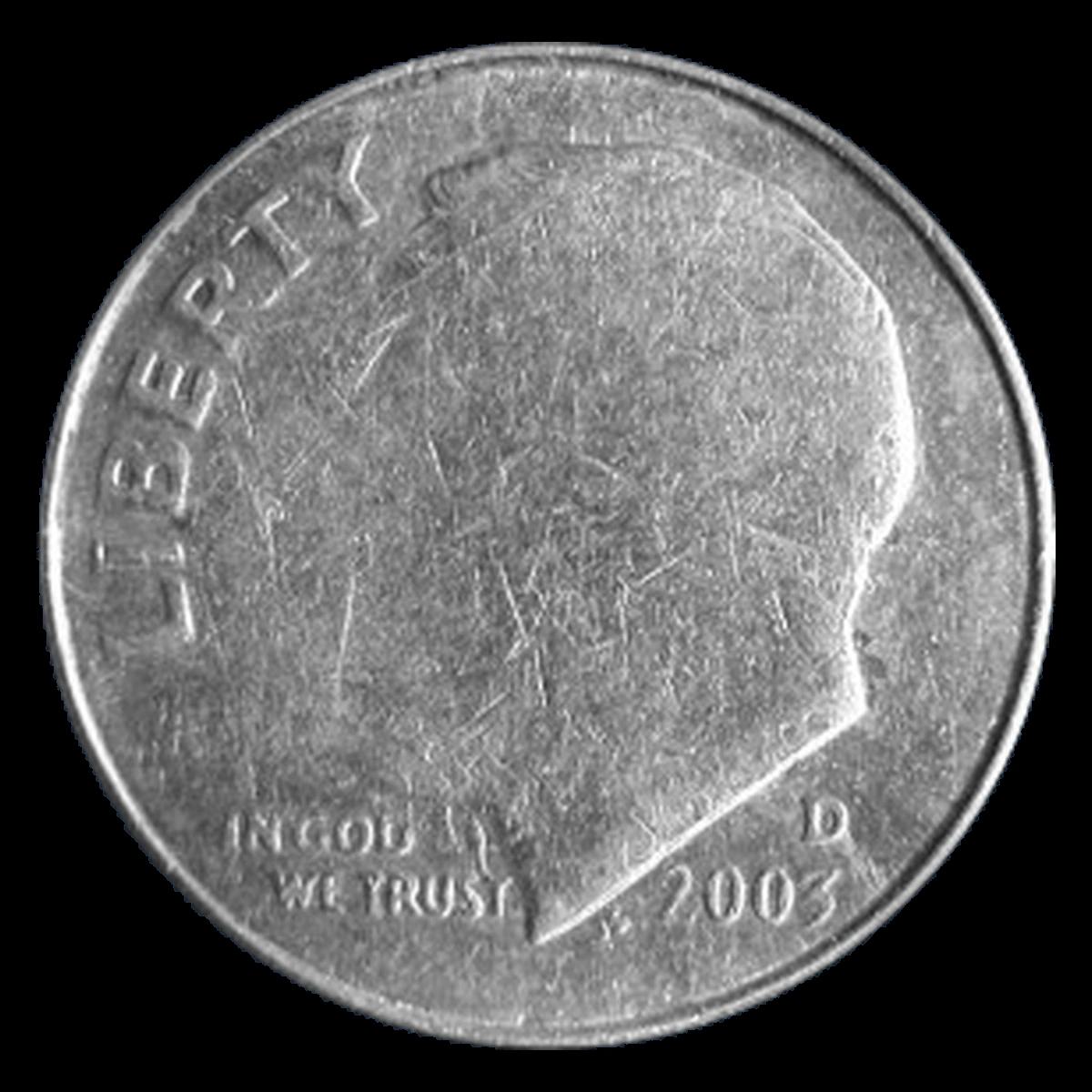
Mike Diamond described a Denver dime with a collapsed reverse die and weak striking. Its reverse has a blank raised center, while the front center is hollow.
The coin also carries clashes and cracks through the N in ONE and between UNITED and STATES. Those features do not establish the order in which the faults developed.
How to Identify
The described specimen weighs 2.24 grams and measures 17.76 millimeters. Its edge grooves are strongest near twelve o’clock and absent from roughly 4:30 to nine.
Compare the bulge, hollow, cracks, and edge with Diamond’s illustrated coin. Original pre-strike marks in the blank center help distinguish it from grinding or ordinary wear.
What It’s Worth
A working estimate is $300–$1,500 for a genuine matching combination. It reflects unusual shape and a published specialist explanation.
No sale price is supplied for that specific coin. Its weak strike, cracks, and clashes are parts of one object, not prices to add independently.
12. 2003 Dime Repeated Motto on a Reported Proof: Doubled Die Error
IN GOD WE TRUST is the proposed doubled area on a reported 2003-S Proof. A true doubled die contains repeated design outlines before striking.
The guide combines a Proof description with an MS grade, creating an identity conflict. It also does not settle whether the claimed coin is clad or silver.
How to Identify
Check the S mintmark, actual finish, and complete holder description. Compare the motto with an identified example of that same issue.
Change lighting to separate reflections from a real second contour. Flat mechanical ledges and a lone thick letter are insufficient for a doubled-die attribution.
What It’s Worth
A confirmed matching 2003-S Proof has a conditional estimate of $100–$1,200. The upper part requires clear doubling and strong preservation.
The guide’s $1,180 claim retains the Proof-versus-MS conflict. It should not be presented as a settled sale comparison.
13. 2003 Dime Only One Face Sits Sideways: Misaligned Die Error
A die shifted sideways can leave uneven borders on one face while the other design remains centered. This is different from rotating a design or placing the whole blank off center.
The 2003-S Proof report again has conflicting finish and grade information. Its metal and exact identity require confirmation.
How to Identify
Photograph both faces straight on at the same scale and compare letter-to-rim distances. The relative placement of the two designs is the key evidence.
Missing design beside an unstruck crescent on both faces suggests an off-center blank instead. A tiny uneven border on a circulation dime is a much more modest comparison than a significant Proof error.
What It’s Worth
For a verified significant shift on the claimed 2003-S Proof issue, the conditional range is $100–$1,350.
The guide’s $1,320 figure has an unresolved Proof-versus-MS description. Neither the transaction nor its applicability to an ordinary dime should be treated as settled.
14. 2003 Dime A Cup or a Covered-Die Impression: Die Cap Report Error
A cap is the coin that sticks to a die and can spread around it as later blanks arrive. A subsequent coin struck beneath that cap is a separate receiving object.
The Denver guide report mixes the two descriptions. A curved outline or faint design alone cannot determine which one it intended.
How to Identify
For a cap, examine how the metal and design formed around the tool. For a receiver, inspect the blocked design and any recessed backward impression separately.
A receiver need not be cupped, and not every cap-struck coin shows a readable mirror image. Exclude later bends or crushing before assigning either identity.
What It’s Worth
A genuine cap suggests a conditional $500–$1,500 range; a coin struck through a cap suggests $200–$1,350.
The reported $1,315 Denver figure does not clearly identify which object was sold. It cannot resolve that distinction or establish a price for both categories.
Conclusion
Complete design, missing blank metal, and a separated layer tell different stories on a 2003 dime. Establish those physical distinctions before comparing a coin with a high-priced listing or a loosely described guide entry.
The documented elliptical sale and cent-stock asking price are useful only for their respective coins. Reports with uncertain finish, grade, or cap identity remain conditional until the actual specimen provides a clear match.