Rare 2009 Presidential Dollar Errors (List & Pictures)
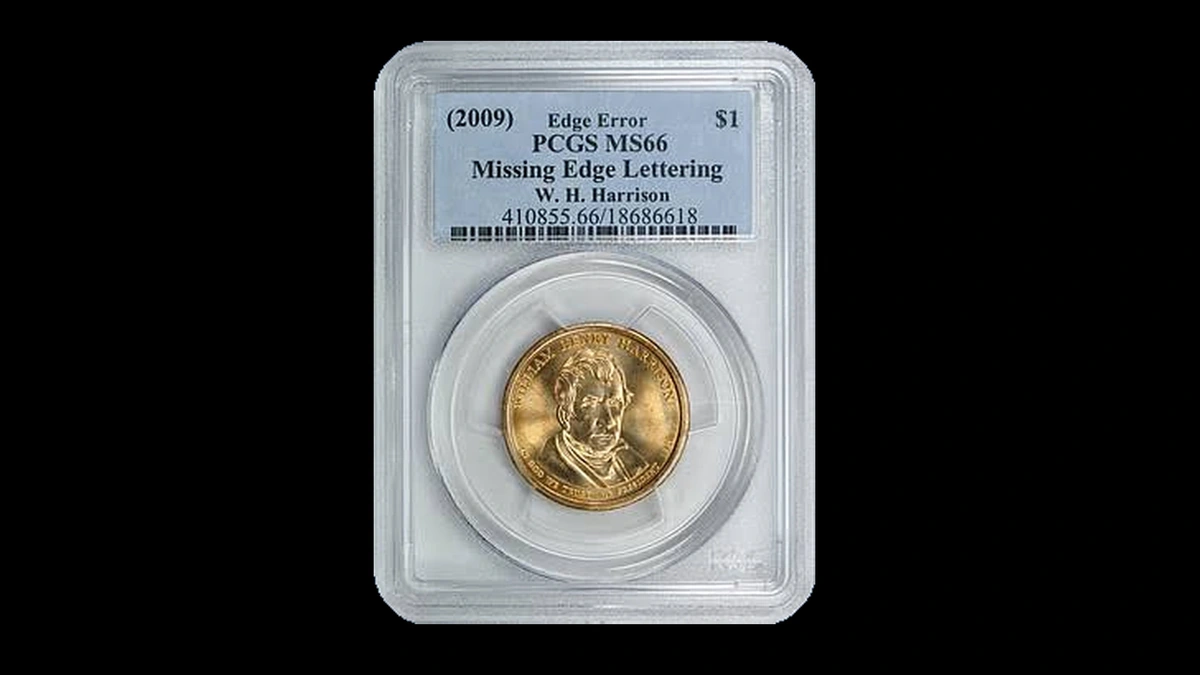
A dollar’s portrait and edge must tell the same story, making both essential when identifying 2009 Presidential dollar errors. A Taylor dollar with completely missing edge lettering sold for $432 in December 2020, the highest completed sale supplied here.
Estimates span $15–$10,000, with the upper range reserved for an authenticated Taylor dollar carrying a 2010-D edge date. Follow the portrait, full edge inscription, and surface interruptions to separate the five groups below.
| Observation | Error group | Estimated value |
|---|---|---|
| Blocked portrait detail | Harrison strike-through | $25–$300 |
| Taylor with 2010 D on edge | Wrong edge date | $1,000–$10,000 |
| Absent or shallow characters | Missing, weak, or tilted lettering | $15–$700 |
| Interrupted UNUM and changed gaps | Shifted lettering | $20–$150 |
| Two readable sequences | Overlapping inscriptions | $40–$600 |
1. 2009 Dollar Interrupted Detail on Harrison’s Portrait: Struck-Through Patches Error
Inspect the lower edge of Harrison’s portrait and the areas around the W for an irregular interruption. Reported 2009-P examples show affected patches at the portrait base or above and below the W, on separate coins.
Material between the die and blank blocked the intended design during striking. The supplied report does not identify that material, so the marks should not automatically be called grease, cloth, or wire impressions.
How to Identify
Study the boundary between normal detail and the depressed or incomplete area. Determine whether the feature appears pressed into the coin or cut across it by a later scrape.
Check surrounding high points for wear and the patch for directional grinding lines. Broad rubbing can flatten a portrait without any foreign material having interrupted its original strike.
The reported locations provide starting points, not a requirement that all the patches occur together. Leave any attached material in place so its connection with the interrupted design can be examined.
What It’s Worth
$25–$300 is the supplied estimate for genuine Harrison strike-through examples. An obvious patch with original surrounding surfaces is easier to compare than faint weakness mixed with later damage.
Ken Potter’s report on 2009-P Harrison dollars describes the portrait and letter-area marks. It does not establish that a particular foreign object caused them.
A 2014-P Native American dollar with a front strike-through sold for $31 in October 2016. That different-year design and affected area provide a broad comparison, not a Harrison sale record.
2. 2009 Dollar Taylor’s Portrait with a 2010 Date: Wrong Edge Date Error
Zachary Taylor belongs to the 2009 Presidential dollar issues, but an authenticated example has 2010 D impressed into its edge. The mismatch concerns the production year, not the dates of Taylor’s presidency printed beside his portrait.
Ordinary Presidential dollars receive edge lettering after their faces are struck. This separation allows a coin to acquire an inscription from equipment set for another issue without changing the portrait already on its face.
How to Identify
Read ZACHARY TAYLOR on the face and then locate 2010 and D on that same coin’s edge. Record the portrait and edge sequence together so the evidence cannot accidentally combine two dollars.
Check the numerals for freshly cut strokes, disturbed metal, or signs of an altered digit. The complete inscription should have the character of original machine-applied lettering.
NGC authenticated the wrong-date Taylor dollar after its discovery in a roll of 2010-D Native American dollars. A Taylor coin left between production steps is a suggested explanation, rather than a witnessed account of its precise path through the Mint.
A normal 2010 Presidential dollar does not meet this identification. The required evidence is the incompatible Taylor portrait and original 2010-D edge on one genuine coin.
What It’s Worth
$1,000–$10,000 is the supplied rarity estimate for an authenticated example of this mismatch. It is not a reported selling price for the discovery coin.
Readable original lettering, condition, and confirmation of the complete pairing are central to any comparison. A changed digit cannot be valued as the genuine wrong-date error.
3. 2009 Dollar A Bare or Unevenly Lettered Edge: Missing, Weak, or Tilted Lettering Error
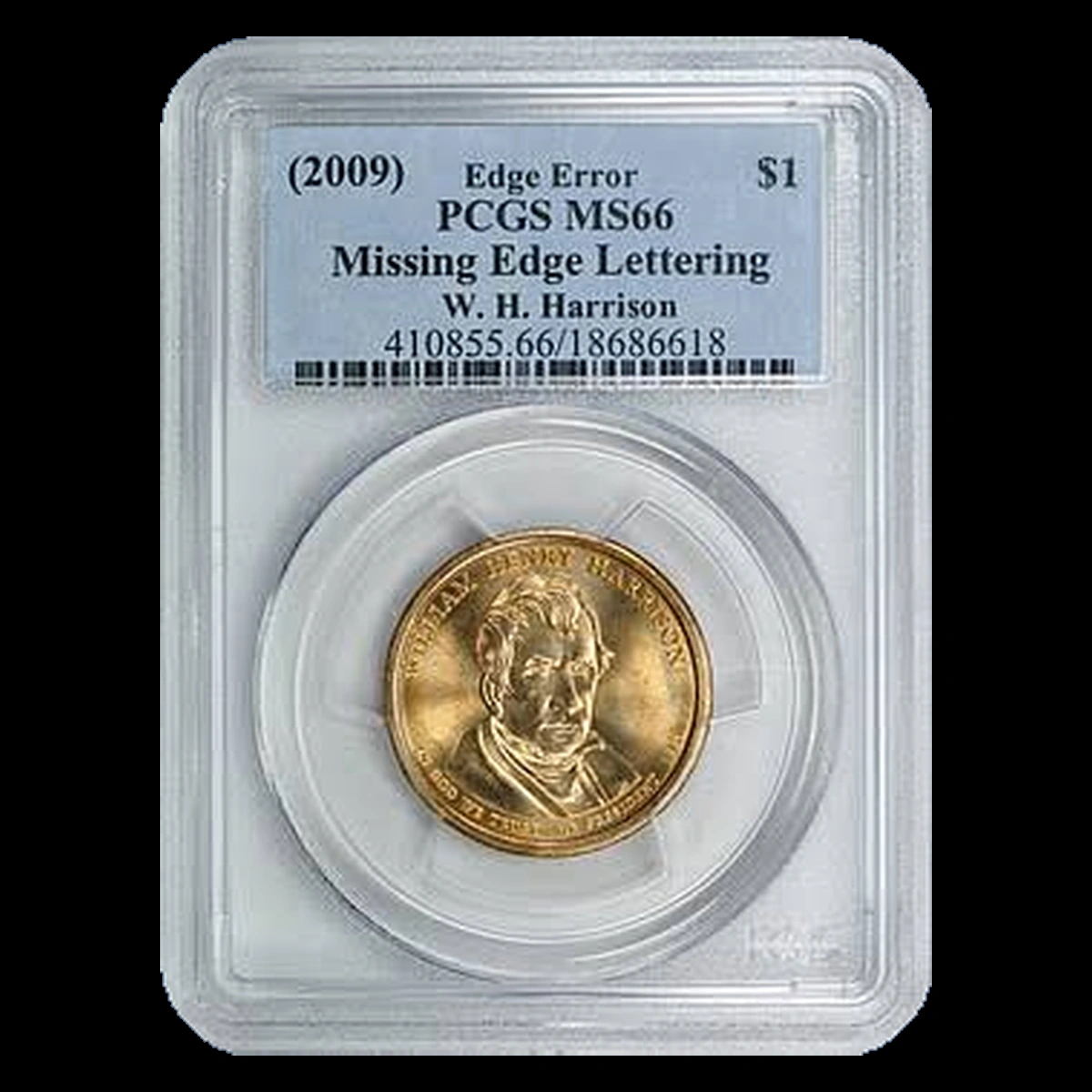
Follow the full circumference before deciding that an inscription is missing. Some Taylor dollars retain weak lettering, while reported Philadelphia Harrison tilted-edge examples show stronger upper portions and weaker lower portions of their characters.
These patterns reflect a missed or uneven edge-lettering operation. Complete missing-edge types are cataloged for Harrison, Tyler, Polk, and Taylor, with a separate satin-finish Harrison report.
How to Identify
For weak Taylor lettering, move the light to reveal shallow cuts. Any surviving original characters distinguish weakness from complete absence.
On a tilted Harrison inscription, compare the tops and bottoms of the date digits and mintmark. A P with its lower portion poorly impressed may resemble a short D, but that distortion does not establish a Denver mintmark.
Inspect both rim junctions for filing or polishing that could have removed the lettering. A normal dollar is about 26.5 millimeters wide, so a reduced diameter may help expose alteration, although normal width alone proves little.
Record the president and finish as well as the edge. Satin finish is the soft-looking collector surface, not a description of circulation wear, and it needs a finish-matched comparison.
What It’s Worth
$15–$700 is the combined supplied estimate, divided into $15–$150 for weak or tilted lettering and $30–$700 for complete missing-edge examples. President, finish, and preservation can substantially change the appropriate comparison.
A Taylor dollar with missing edge lettering in PCGS MS68 sold for $432 at Heritage in December 2020. MS68 denotes an exceptionally well-preserved unworn coin, so that sale is not a ready-made price for a worn example or the satin Harrison report.
4. 2009 Dollar Damaged UNUM with Changed Gaps: Shifted Harrison Edge Lettering Error
On the reported 2009-P Harrison pattern, the last part of UNUM is interrupted and the following stars crowd together. A larger gap then separates that area from the date.
Movement during a single lettering pass can damage characters and change their spacing together. This shifted pattern differs from two complete inscriptions produced by two passes.
How to Identify
Start at the second U in UNUM, which is largely lost on the reported pattern, and the absent M beside it. Continue through the stars to the enlarged gap before the date.
Compare this entire sequence with a normal 2009-P Harrison edge at the same scale. Scraping alone is insufficient; the altered spacing and interrupted letters need to form the connected pattern.
Read the rest of the circumference for a second independent inscription. If two full sequences can be traced, investigate overlapping lettering rather than calling all the crowding a shifted pass.
What It’s Worth
$20–$150 is the supplied estimate for a clearly matched Harrison shifted-edge example. Visibility of the disrupted sequence and preservation of the edge influence its usefulness to collectors.
Mint Error News reported a 2009-D Taylor slipped-edge dollar at $16.59 in its October–December 2010 sales survey. That coin was described as ANACS MS65, but its different president and mint make it a comparison rather than a Harrison result.
5. 2009 Dollar Two Dates or Words in the Same Area: Overlapping Edge Inscriptions Error
Repeated edge lettering can leave two versions of a date or word pressed into the same narrow surface. The coin passed through the edge-lettering equipment twice, creating independent strings of recessed characters.
The PCGS registry lists overlapping types for Philadelphia Harrison, Tyler, and Taylor dollars, as well as Denver Polk and Taylor examples. The specific president and mint still matter when choosing reference photographs.
How to Identify
Choose a readable repeated character and trace its neighboring letters into a second sequence. Both inscriptions should be recessed, rather than an isolated raised impact or random scrape.
Photograph overlapping sections around the edge while keeping the orientation consistent. Flipping an image does not reveal an additional inscription on the physical coin.
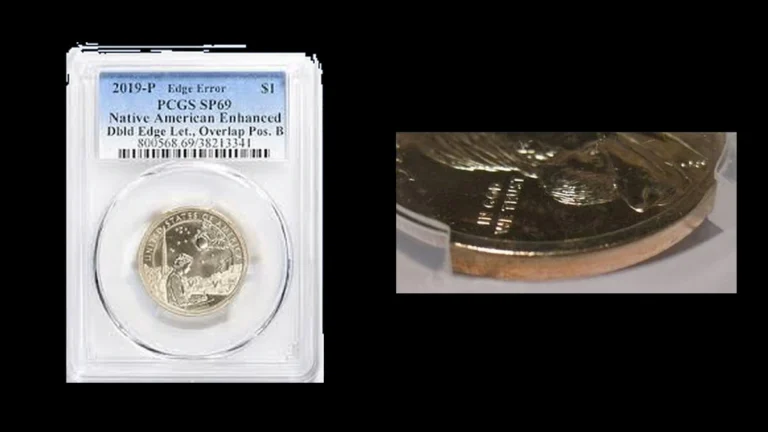
Normal Position A and Position B describe opposite reading directions of a single inscription. They do not imply doubling, and a shifted one-pass pattern does not become a second inscription merely because its letters overlap visually.
What It’s Worth
$40–$600 is the supplied estimate for genuine overlapping-edge examples. A second readable date or word generally makes the identification clearer than one confusing letter.
A 2007-P John Adams overlapping-edge dollar, described as unworn, sold for $59 in March 2010. This earlier-year result does not establish a price for every listed 2009 president-and-mint combination.
Conclusion
Read a 2009 Presidential dollar as a complete object: portrait, finish, and full edge inscription together. A short-looking P, a disrupted word, and two complete strings of letters explain different production events.
The Taylor wrong-year edge requires especially clear evidence that the face and original 2010-D lettering belong to the same coin. Preserve faint characters and surface marks, since those details help separate genuine Mint features from later removal or alteration.