Rare 1849 Quarter Errors (List & Pictures)
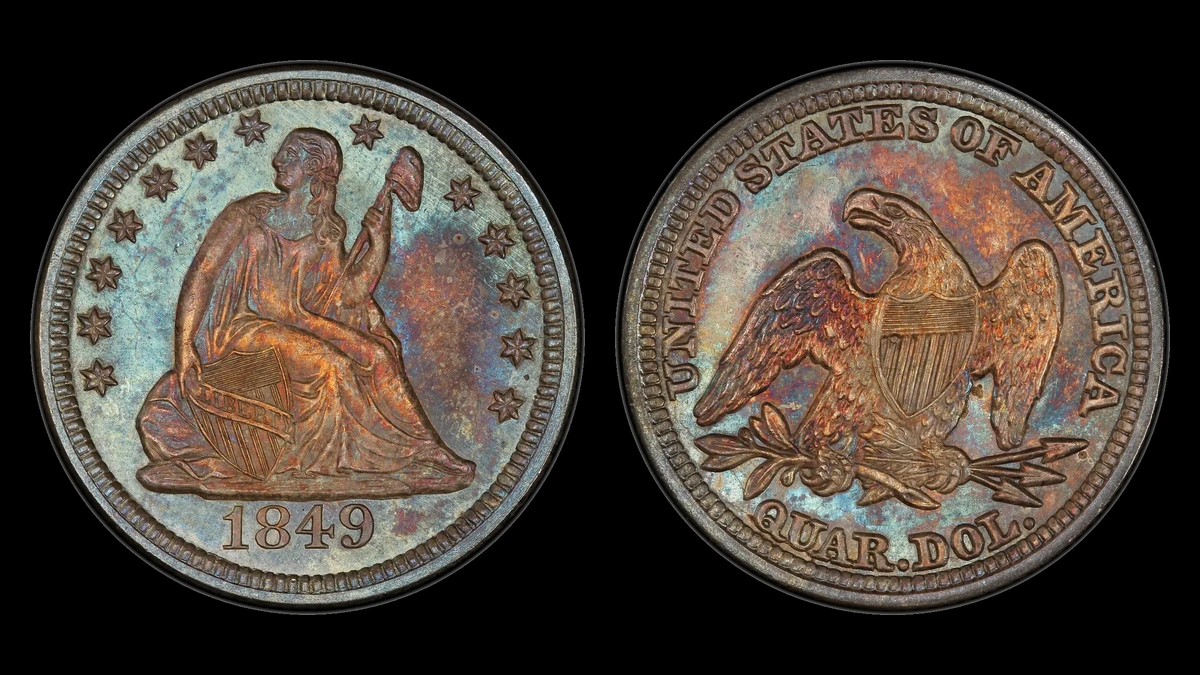
A small shield interruption and faint reverse cracks can appear together among 1849 quarter errors. The documented NGC MS65 Briggs 1-A example sold for $8,812.50 on May 12, 2015, including both features and its strong preservation.
Supplied whole-coin estimates span $50–$12,000. Locate the specific gap in the shield first, then trace raised lines around the reverse lettering without confusing them with scratches.
1849 Quarter A Circular Break in One Shield Stripe: Compass Point Feature Error
The leftmost vertical stripe of the eagle’s shield has a small rounded interruption near its top. This position and shape identify the Compass Point feature associated with Briggs 1-A.
It is missing design detail inherited through the working die, not silver peeling off the finished quarter. The traditional nickname connects the feature to a centering mark used during design preparation.
For identification, the visible interrupted stripe matters more than interpreting the nickname as a literal hole. A pit elsewhere in the shield is a different observation.
How to Identify
Locate the entire shield before enlarging it with about 10× magnification. Follow the leftmost vertical stripe upward to find the rounded interruption near the top.
Compare a clear authenticated Briggs 1-A reverse at the same orientation. The surrounding stripe arrangement provides fixed landmarks for matching the gap.
Inspect adjacent silver for a pushed-up lip, scrape, or sharp impact. Those may indicate later damage that happens to resemble a small circular missing area.
Keep the full shield in the photograph rather than isolating the gap. Wear can soften stripe tops generally, but does not by itself establish the particular circular interruption.
What It’s Worth
$75–$12,000 is the supplied estimate for the entire Compass Point quarter from worn through high-grade examples. Original surfaces and the amount of remaining detail explain much of that wide spread.
Heritage sold the NGC MS65 Briggs 1-A for $8,812.50 on May 12, 2015. MS65 indicates an unworn coin with relatively few marks.
The catalog also describes early reverse cracks on that same specimen. Its auction price already includes those accompanying features, so no additional crack value should be added.
1849 Quarter Raised Lines Through the Outer Lettering: Die Cracks Error
A crack in the steel die allows silver to enter the opening during striking. The finished coin records that opening as a narrow raised ridge crossing letters or the surrounding field.
The auctioned Briggs 1-A has only faint beginnings of reverse cracks. Stronger lines may develop as a die deteriorates, but a more advanced pattern requires its own comparison.
Lines below the date have also been reported. Their location alone cannot establish that they came from a cracked tool.
How to Identify
Follow the suspected reverse line through its start, bends, letter intersections, and endpoint. Record the full route before judging an isolated bright segment.
Change the light direction to assess whether the center rises above the surface or cuts into it. A scratch can push up narrow edges beside an incuse groove, creating a deceptive raised appearance.
Compare the complete path with a documented 1849 quarter rather than assuming every line belongs to Briggs 1-A. The faint early traces on the MS65 auction coin cannot establish all stronger patterns by themselves.
Apply the same raised-versus-cut check below the date. A continuous ridge agreeing with an identified die path is better evidence than a line visible in only one lighting angle.
What It’s Worth
$50–$12,000 is the supplied whole-coin estimate for genuine cracks on 1849 Philadelphia quarters across worn through exceptional condition. Most thin cracks add far less than excellent preservation contributes to the underlying coin.
The $8,812.50 MS65 sale combines faint reverse cracks with the Compass Point shield. It is not a stand-alone premium for a narrow line.
A scratched or heavily cleaned quarter does not become comparable merely because one ridge looks similar. Match the actual variety, crack state, and preservation when evaluating the complete specimen.
Conclusion
The shield stripe and the reverse crack paths provide distinct checks on an 1849 quarter, even when both occur on the same coin. Look for the precise rounded interruption and original raised lines rather than a general impression of missing or extra detail.
The recorded MS65 transaction values one well-preserved specimen with both features. Keep that whole-coin context when comparing worn examples, and never add the two guide ranges together.