Rare 1858 Half Dollar Errors (List & Pictures)
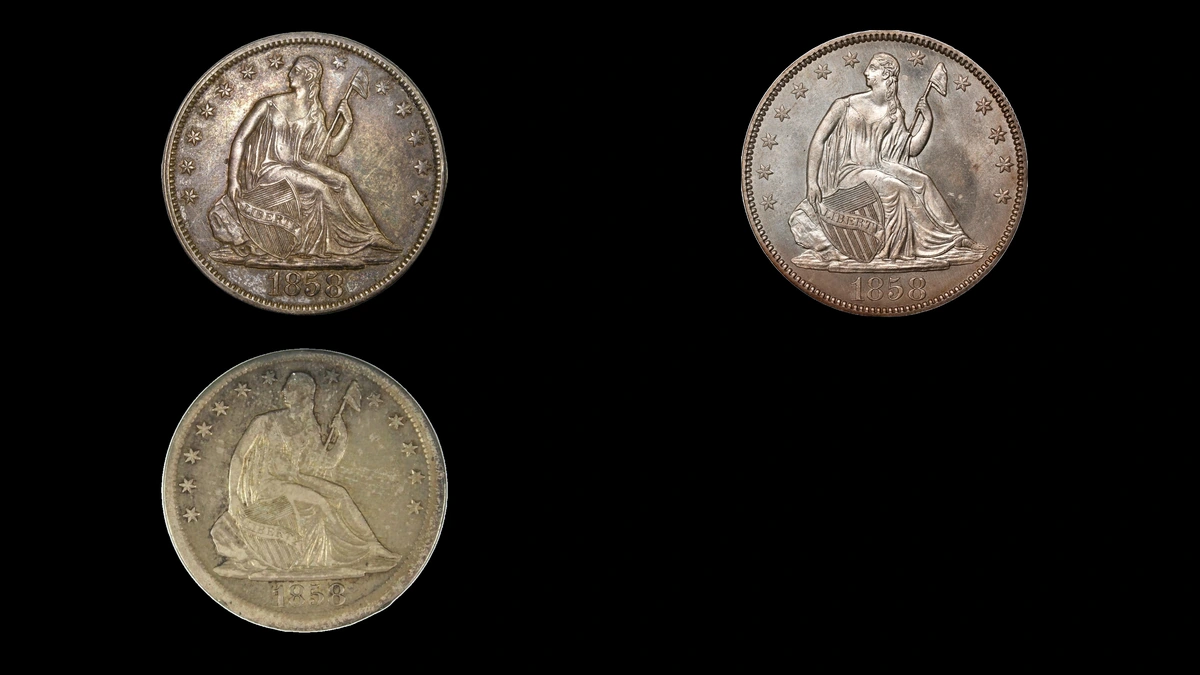
A small extra curve above the date can belong to an important variety, but condition still controls much of its price. An exceptional 1858-S brought $32,900 in October 2014, while a repaired worn example of the variety sold for $156.
Estimated whole-coin ranges for 1858 half dollar errors span $100–$32,900. Begin with the date and mint, then examine repeated details, alignment, the edge, and any disturbed metal.
| What catches the eye | Feature | Estimated value |
|---|---|---|
| Extra numeral stroke | Repunched or misplaced date | $200–$32,900 |
| Extra star or clothing outlines | Doubled die obverse | $250–$1,200 |
| Unfamiliar shapes near Liberty | Clashed obverse die | $150–$750 |
| Eagle tilts after a straight flip | Rotated dies | $100–$600 |
| Shifted design and edge step | Off-center strike and partial collar | $300–$1,500 |
| Front layer separating | Reported lamination | $100–$400 |
| Irregular reverse metal | Reported planchet flaw | $150–$500 |
These halves have grooved edges, no date arrows, and no later reverse motto. Their original standard weight is 12.44 grams and diameter about 30.6 millimeters; measurements of worn coins need allowance for circulation and any lost metal.
1. 1858 Half Dollar A numeral appears twice or outside the date: Repunched and Misplaced Date Error
Read the mintmark before interpreting an extra date stroke. Philadelphia, New Orleans, and San Francisco examples do not all share the same misplaced or repeated numeral.
Earlier positions of a date punch could leave traces beside the final numerals or farther away in the rock and border. These are features of individual dies, not marks every 1858 half dollar should possess.
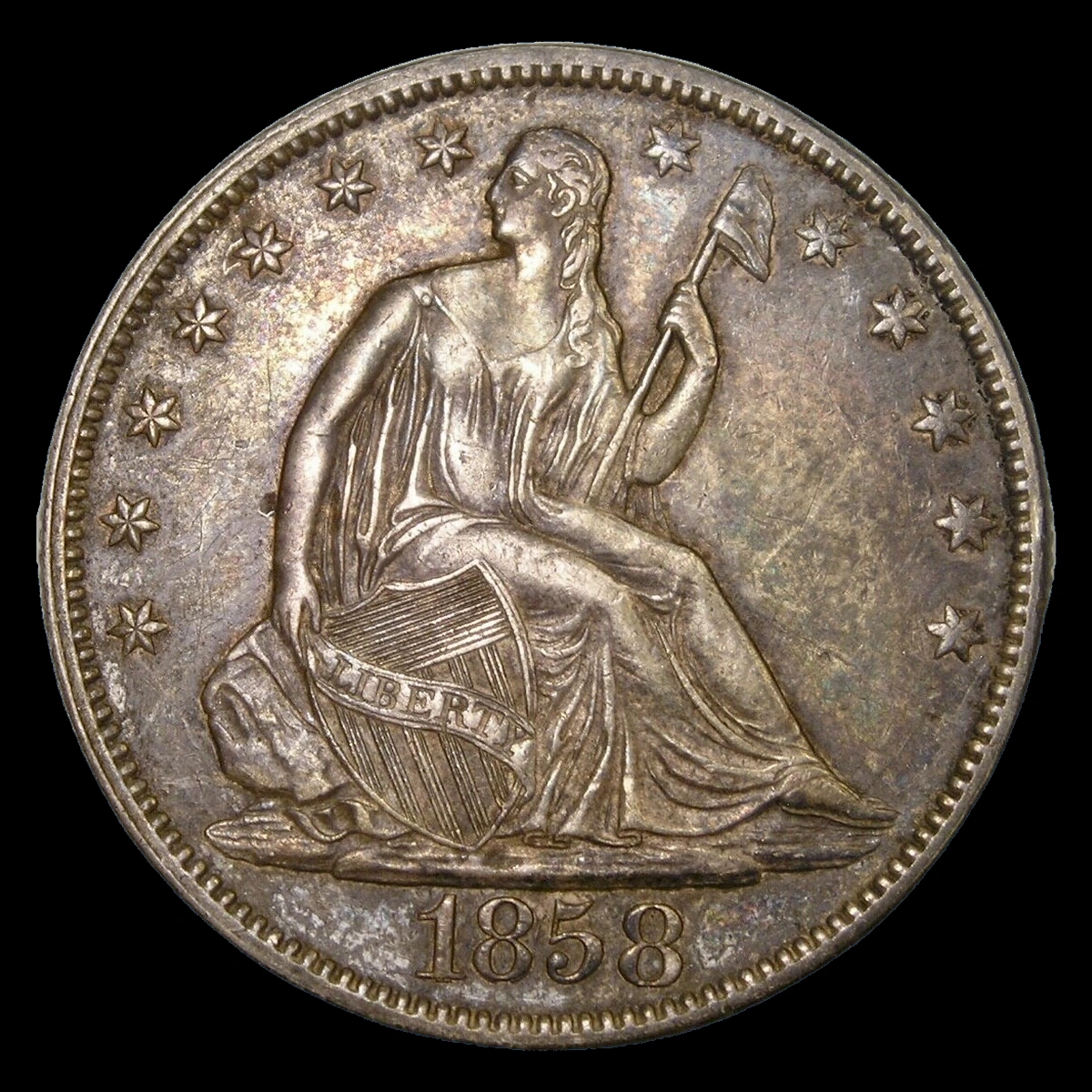
How to Identify
For the documented San Francisco variety, inspect the rock above the last 8 for a curved piece of another 8. The cataloged 1858-S example provides that specific comparison.
Philadelphia reports include extra strokes around 18 and the final 8, plus an upside-down 1 between 5 and 8. New Orleans reports also include marks beside or outside the date, but the exact candidate must match its own reference.
Trace enough of a shape to distinguish a numeral from normal rock lines, damaged border teeth, or a later cut. Check the mintmark area for alteration before selecting a mint-specific attribution.
What It’s Worth
Estimated ranges are $200–$1,500 for comparable worn date-punch varieties and $3,500–$32,900 for the cited unworn San Francisco quality levels. These are whole-coin values, not premiums assigned to a single extra curve.
The San Francisco price records include $156 for a repaired example in 2020 and March 2024 results of $3,840 in MS63 and $10,200 in MS65. An MS66 brought $32,900 in October 2014.
MS grades describe unworn coins, with higher numbers generally reflecting better preservation. Repairs and heavy wear remain material differences even when the variety matches.
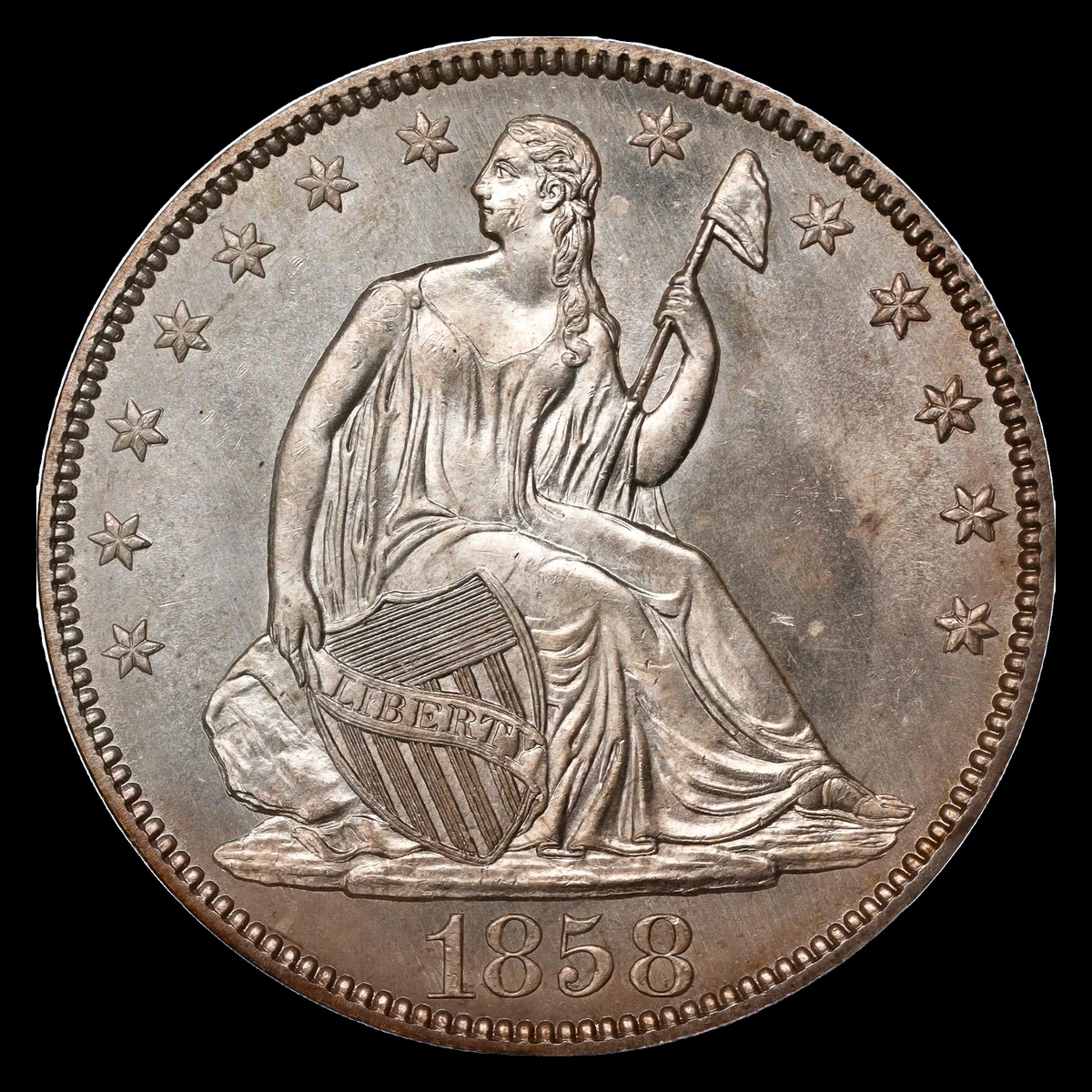
2. 1858 Half Dollar Stars and clothing carry extra outlines: Doubled Die Obverse Error
Move away from the numerals to the stars on Liberty’s left and the folds of her clothing. Reported Philadelphia doubled obverses show changes in the main design that were already present in the die before striking.
More than one doubled front is recognized for 1858. Mixing details from different dies would create a checklist that no individual coin needs to satisfy.
How to Identify
Compare several stars and the appropriate clothing folds with photographs of the same variety. Stable additional outlines or changed shapes are more informative than a reflection on one worn edge.
Flat shelves from movement during striking can imitate doubling. Extra date strokes alone also do not establish this category, because a separately shifted date punch can explain those.
Confirm Philadelphia’s absence of a mintmark and retain the full portrait in the photographs. The useful match should extend to the documented design details rather than an isolated doubled-looking digit.
What It’s Worth
An estimated $250–$1,200 applies to identified worn through nearly unworn examples with readable doubling. Surface appeal and clarity affect the comparison within that range.
Heritage cataloged an NGC AU53 doubled obverse in November 2025, but no realized price from that listing is supplied here. Exceptional unworn coins require separate comparisons.
3. 1858 Half Dollar Unexpected shapes beside the arm and leg: Clashed Obverse Die Error
Specialist Bill Bugert documents strong extra traces beside Liberty’s right arm and leg and in nearby flat areas on a Philadelphia example. The reverse paired with that obverse is described as unclashed.
A die clash starts when the dies meet without a blank between them and acquire traces of the opposing design. Reuse and later pairing of dies can leave those traces more evident on only one face of a subsequent coin.
How to Identify
Examine the specified areas under low light and compare the shapes with the reverse design positioned as the dies would have met. A recognizable connection to the opposite design matters more than simply finding a line nearby.
Scratches and polishing lines need not follow any such design shape. An unmarked reverse does not rule out the documented obverse clash when the dies were paired in that condition.
What It’s Worth
The estimated whole-coin range is $150–$750 for worn Philadelphia examples with clear matching obverse traces. Better surviving detail makes shallow clash marks easier to evaluate.
An 1862 Philadelphia half with clashes sold for $299.63 in May 2015, graded AU55 Details for polished surfaces. That almost unworn but impaired, different-year coin is a limited comparison rather than a sale of Bugert’s 1858 example.
4. 1858 Half Dollar The reverse finishes slightly tilted: Rotated Dies Error
A subtle alignment difference can disappear when someone straightens each photograph separately. Bugert records approximately 10 degrees of clockwise reverse rotation on a Philadelphia 1858.
This concerns the relative positions of the dies, the tools stamping the two faces. Both designs can remain complete and centered despite their different alignment.
How to Identify
With Liberty upright, flip the coin top to bottom without a sideways turn. Repeat against a fixed vertical reference and measure where the eagle finishes.
For the recorded example, the reverse should consistently finish about 10 degrees clockwise from upright. Prevent slipping inside a case, which can imitate a small tilt.
Confirm the Philadelphia issue and inspect the edge for seams or alteration. A slanted eagle in an isolated photograph cannot establish the physical relationship between the faces.
What It’s Worth
Estimated worn-coin values are $100–$600 for comparable Philadelphia examples with this small rotation. Ordinary circulated value supplies most of the basis.
No separate realized price or fixed rotation premium is assigned to Bugert’s coin. A slight tilt should not inherit a comparison intended for a dramatic quarter-turn rotation.
5. 1858 Half Dollar The design shifts and the edge develops a step: Off-Center Strike and Partial Collar Error
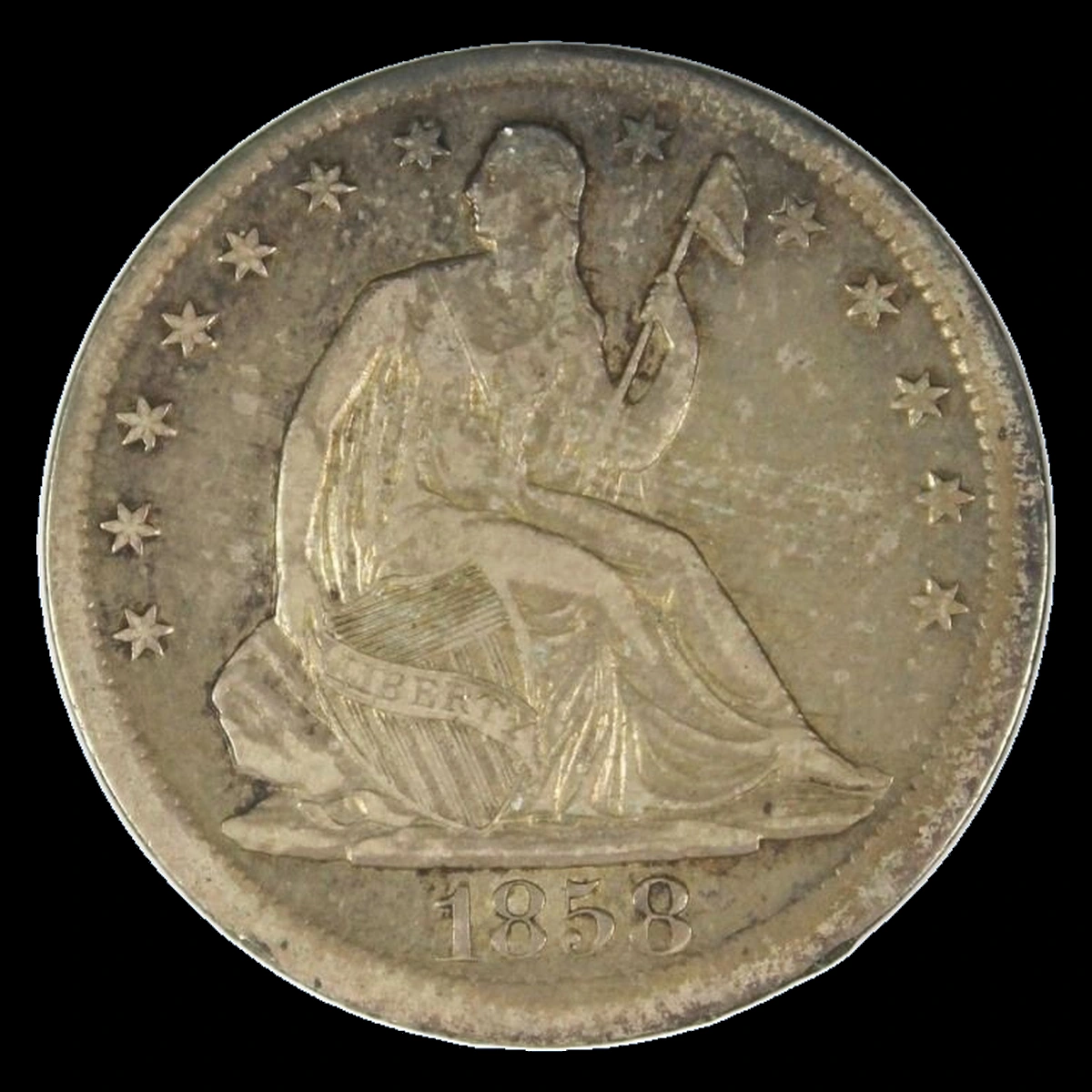
One auctioned 1858-O combines an approximately 10% shifted strike with a stepped edge and partial grooves from 9 to 1 o’clock. The edge effect shows that the collar restrained only part of the coin’s thickness during striking.
A separate illustrated NGC AG3 1858-O is about 10% off center toward 8:30. That heavily worn coin’s direction does not automatically describe the auction specimen.
How to Identify
Photograph both faces to preserve the date, O, and relationship between the displaced design and any bare metal. Then photograph the edge directly to examine the step and partially formed grooves.
The auction description places partial grooving from 9 to 1 o’clock. The published AG3 illustration documents another coin’s offset and cannot prove the same collar effect.
Measure the outline and accessible weight as supporting observations. Each claimed feature must remain tied to the specimen that actually shows it.
What It’s Worth
An estimated $300–$1,500 covers comparable identifiable worn examples with clear design or edge effects. Preservation and the visibility of the accident influence the whole-coin value.
The February 2020 R. Howard listing records a $300 floor result before any buyer’s fee, against a $500–$600 estimate. No sale is assigned to the separate AG3 illustration, and the auction coin’s two effects are not priced as separate objects.
6. 1858 Half Dollar A front-side layer appears to peel: Reported Lamination Error
A dealer suggested lamination on an 1858-O obverse, without specifying the exact area. Lamination occurs when a weak internal bond lets a thin layer of metal separate, sometimes leaving a flap or shallow exposed patch.
The suggested cause needs support from the actual surface. A rough spot alone could also involve corrosion, scraping, or another form of damage.
How to Identify
Inspect the boundary with angled light, seeking a thin layer or lifted edge beneath the original surface. Check how the nearby struck design meets it instead of accepting a color change as proof.
Leave loose metal untouched and confirm the reverse O. Do not borrow an exact obverse location from another coin when the report gives none.
What It’s Worth
A worn 1858-O with clear shallow separation has an estimated $100–$400 range. Remaining detail and original surfaces determine the most useful comparison.
The separate reverse planchet-flaw report carries a $265 dealer offer, providing only limited context. It is not a sale of this obverse candidate or proof that its surface peeled.
7. 1858 Half Dollar The reverse has irregular original metal: Reported Planchet Flaw Error
The broad phrase “planchet flaw” points to a problem in the metal disc before striking. A dealer used that description for the reverse of another 1858-O without specifying a clip, a separating layer, or an exact cause.
This report therefore belongs apart from the obverse lamination. An examination should test the broad claim before narrowing it to a more specific error.
How to Identify
Look where the reverse design meets the irregular area and consider whether the details formed around it. A flaw already in the blank can interact with the strike differently from damage that removes finished design later.
Compare its boundaries with undisturbed silver, checking for digging, impact damage, and corrosion. Roughness alone cannot establish either the dealer’s attribution or a peeling-layer diagnosis.
What It’s Worth
The estimate is $150–$500 for a worn example with an identifiable original metal flaw and readable nearby details. A lamination premium should not be assumed without visible separation.
The year reference records a $265 dealer offer. That amount is an asking price and supplies neither a completed transaction nor a numerical grade.
Conclusion
Choose the mint before matching an extra numeral, and choose the correct specimen before assigning an edge feature or strike direction. The different 1858-O reports cannot be assembled into one imaginary coin.
Surface structure is equally important: a thin separating layer supports lamination, while a broad metal-flaw description leaves the exact cause open. The wide range of San Francisco date-variety results shows how strongly preservation still affects value.