Rare 1873 Liberty Seated Dollar Errors (List & Pictures)
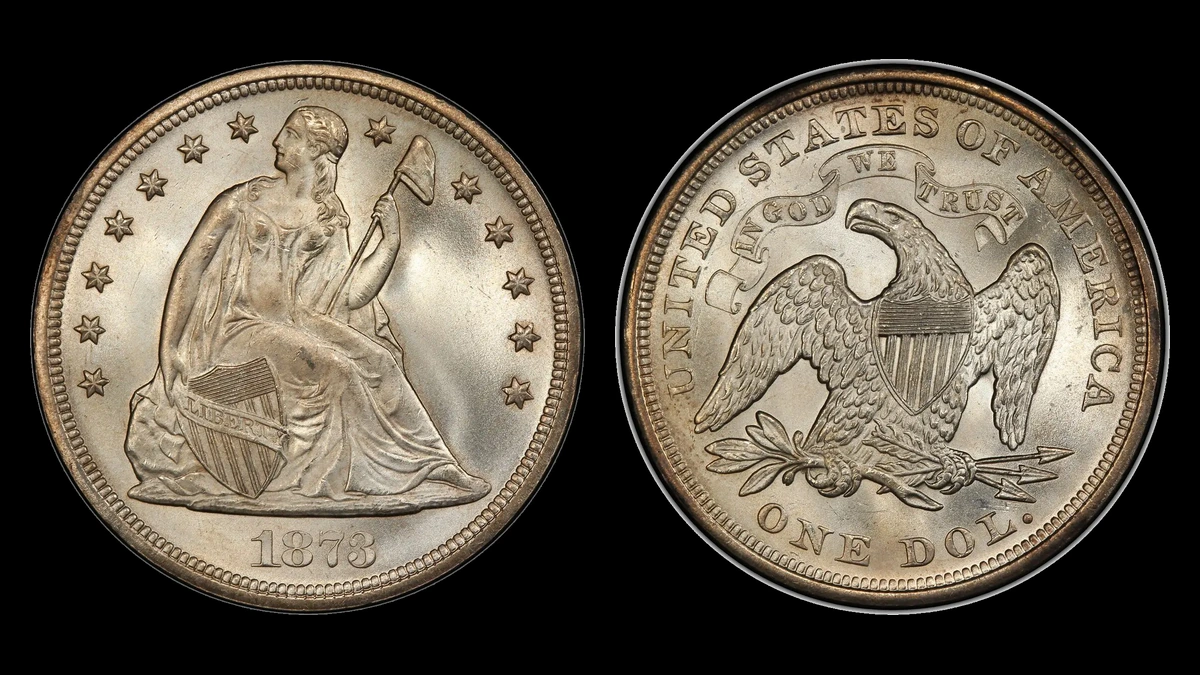
A general 1873 Proof-dollar comparison graded PR66 brought $46,000 in January 2002. This 1873 Liberty Seated dollar errors guide examines a doubled reverse motto, with estimated whole-coin values of $1,500–$50,000.
Read several motto letters together, then confirm the front date and Proof manufacture before choosing a price comparison.
1873 Dollar Extra strokes in IN GOD WE: doubled Proof reverse Error
The motto above the eagle contains the feature to inspect. On the reported Proof pattern, parts of IN GOD WE have separated outlines rather than one clean set of letter edges.
A Proof is a specially made collector coin. Here the repeated design was already present in the die, the steel tool carrying the reverse image.
The feature therefore does not require a second strike to land sideways on the dollar. Coins made from that die could inherit the same extra letter strokes.
Liberty Seated Collectors Club researchers identify the reverse die as one also used for 1872 Proofs. Its repeated motto cannot establish the coin’s front date by itself.
How to Identify
Bring the banner above the eagle into focus with a five- to ten-power magnifier. Include several letters instead of enlarging one bright edge until its context disappears.
Pay particular attention to IN GO and the short feet at the ends of I. Those small extensions are called serifs and can provide useful places to compare the repeated outline.
Move the light while keeping the coin steady. Reflection can change position or vanish, while a physical second raised edge remains in the same place.
Compare connected extra strokes across the motto with an identified Proof photograph. One isolated line is weaker evidence than agreement on several letters.
Inspect the full front for the date 1873. The shared reverse die means a matching motto on an 1872 Proof belongs to another year’s coin.
Have the coin’s Proof identity assessed from both complete faces. Similar-looking marks on an ordinary circulation dollar do not automatically identify this Proof pattern.
Keep the reflective surfaces untouched during the examination. Rubbing or cleaning to make the letters brighter can add fine scratches and reduce the coin’s appeal.
What It’s Worth
Identifiable examples have an estimated whole-coin range of $1,500–$50,000, from impaired or lightly worn Proofs through exceptional high-grade coins.
PCGS lists a PR66 at $46,000 from Bowers & Merena in January 2002. PR66 describes a very well-preserved Proof.
That general Proof record provides condition context. It does not document a separate payment for the doubled motto or establish a fixed variety premium.
Fine scratches across the reflective fields can strongly affect value even when the lettering remains clear. The price comparison must include the whole coin’s wear, marks, and surface quality.
Conclusion
Begin above the eagle and compare repeated edges across the motto, especially IN GO and the feet of I. Confirm the front date because the reverse die was also used on 1872 Proofs.
The estimated range concerns complete Proof dollars in widely differing conditions. Use the PR66 sale as preservation context, while keeping Proof identification and the actual doubled-letter pattern as separate checks.