Rare 1876 Dollar Errors (List & Pictures)
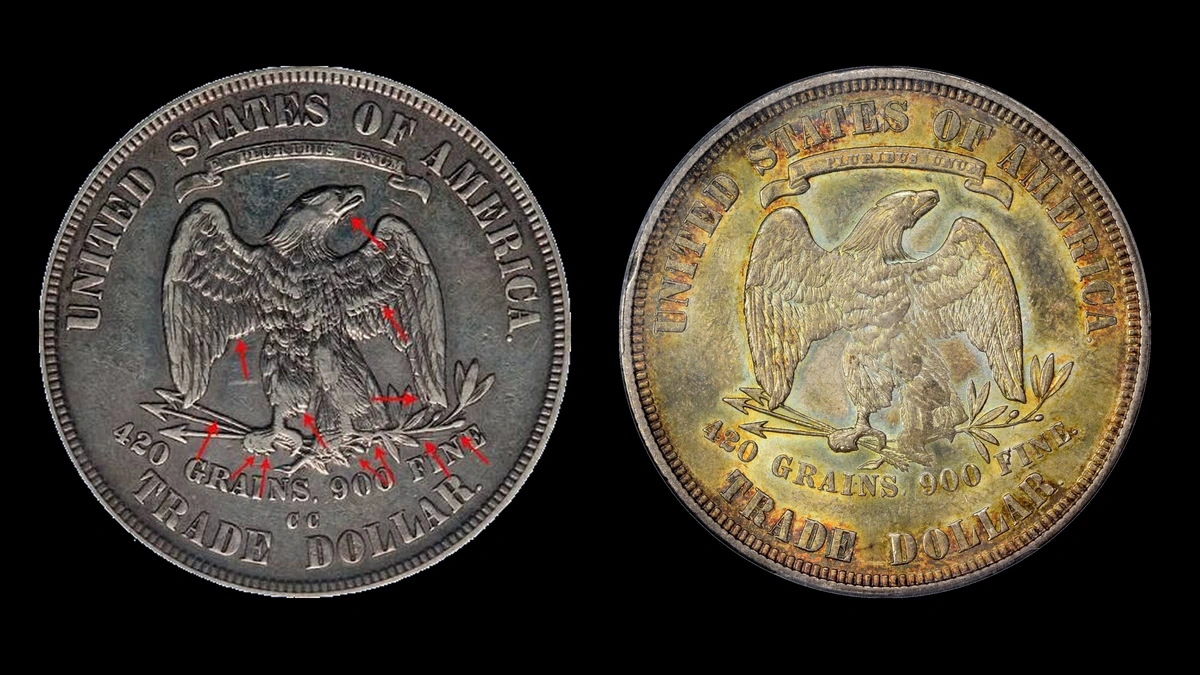
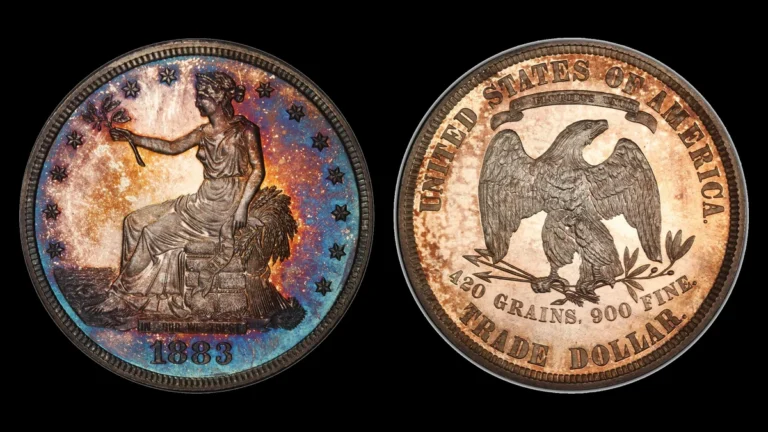
The mintmark determines which close-up matters on an 1876 Trade dollar. A Carson City doubled-reverse coin graded MS64+ sold for $55,200 in September 2019, while San Francisco has different date and portrait patterns.
These four groups of 1876 dollar errors span estimated whole-coin values of $200–$60,000. Follow the mint-specific features, and treat a reported low weight as a measurement to explain rather than proof of an error.
1. 1876 Dollar Repeated Olive Branch or Portrait Contours: Doubled Die Error
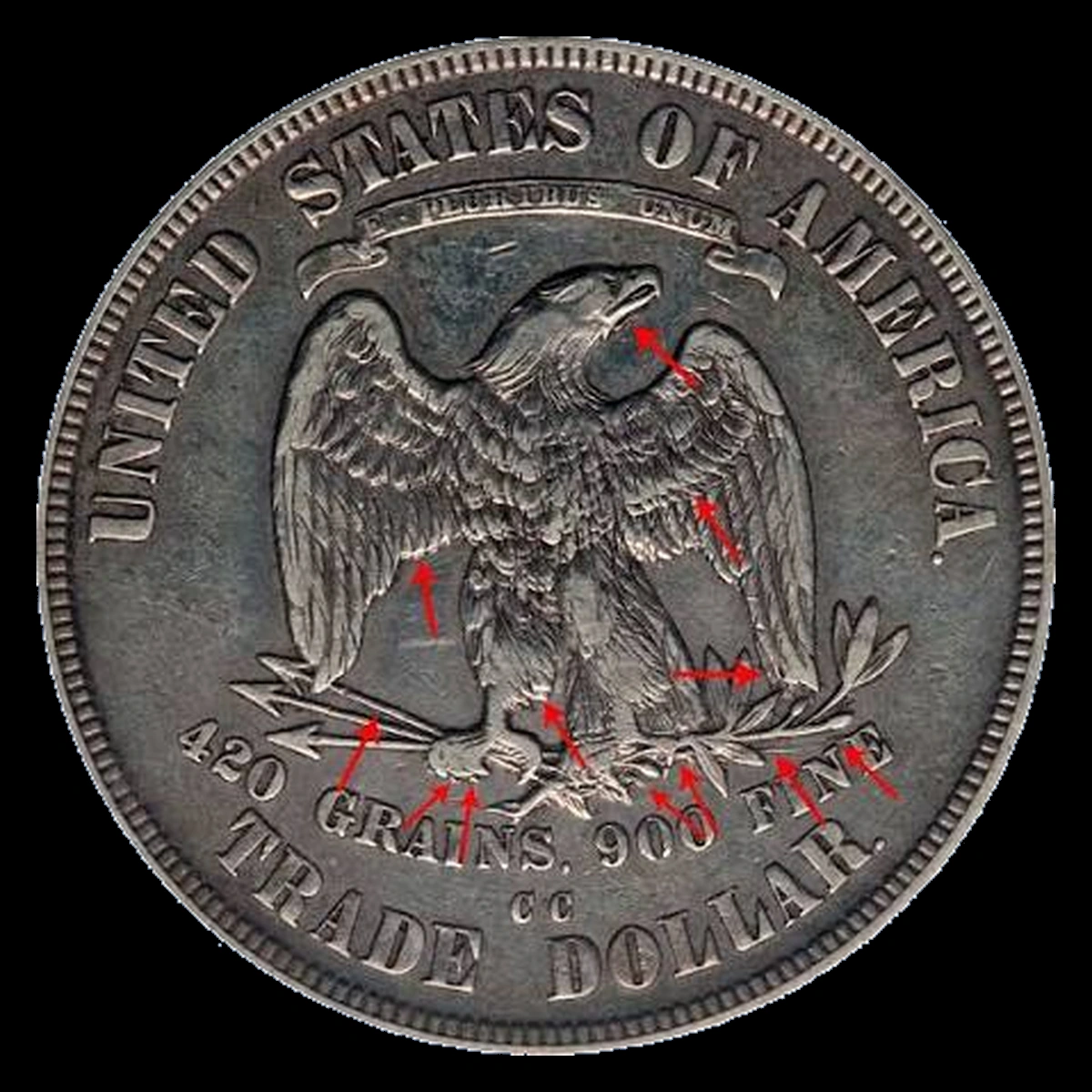
Carson City examples can show strong reverse repetition in the olive branch, lettering, and eagle’s left wing, which appears on the viewer’s right. A separate San Francisco front variety doubles the chin, extended hand, left foot, and clothing.
An older account also reports San Francisco reverse doubling without establishing its precise pattern. Neither the CC reverse nor the S front can supply that missing description.
How to Identify
For CC, start with the olive branch above IN in FINE and compare the lettering and wing. For the S front, move from chin and hand to foot and clothing.
The same matching raised contours should appear in several places. Flat shelves or one thick edge do not replace a documented doubled pattern.
What It’s Worth
$400–$60,000 covers the established groups, with the CC reverse estimated at $400–$60,000 and S front at $1,000–$15,000. PCGS records the CC MS64+ at $55,200 in September 2019, while an S AU50 brought $9,000 in September 2023.
The reported S reverse has a separate conditional estimate of $500–$10,000 after a genuine matching example is established. The other varieties’ sales do not confirm its identity.
2. 1876 Dollar A Second Curve inside 6: Repunched Date Error
An earlier 6 outline can remain inside the final digit on the San Francisco variety. Repositioning the date punch left the trace in the die before it struck the coin.
The variety uses the later front and reverse designs, called Type II. The remnant is another 6, not a 5 or 4 beneath the date.
How to Identify
Confirm the S and keep all of 1876 visible while checking the inner curve. Compare with the repeated-6 reference rather than forcing an irregular mark into an old overdate name.
The matching designs have downward-pointing front ribbon ends and no berry below the eagle’s claw. Those normal details support the comparison without becoming additional errors.
What It’s Worth
$300–$5,000 is the estimate for identified examples from circulated through ordinary unworn grades. Remnant visibility and original surfaces guide the comparison.
The separate San Francisco doubled-portrait variety has different collector demand. Its sale should not be used as though it were a repunched-6 result.
3. 1876 Dollar Raised Lines beneath TRADE or through Stars: Die Cracks Error
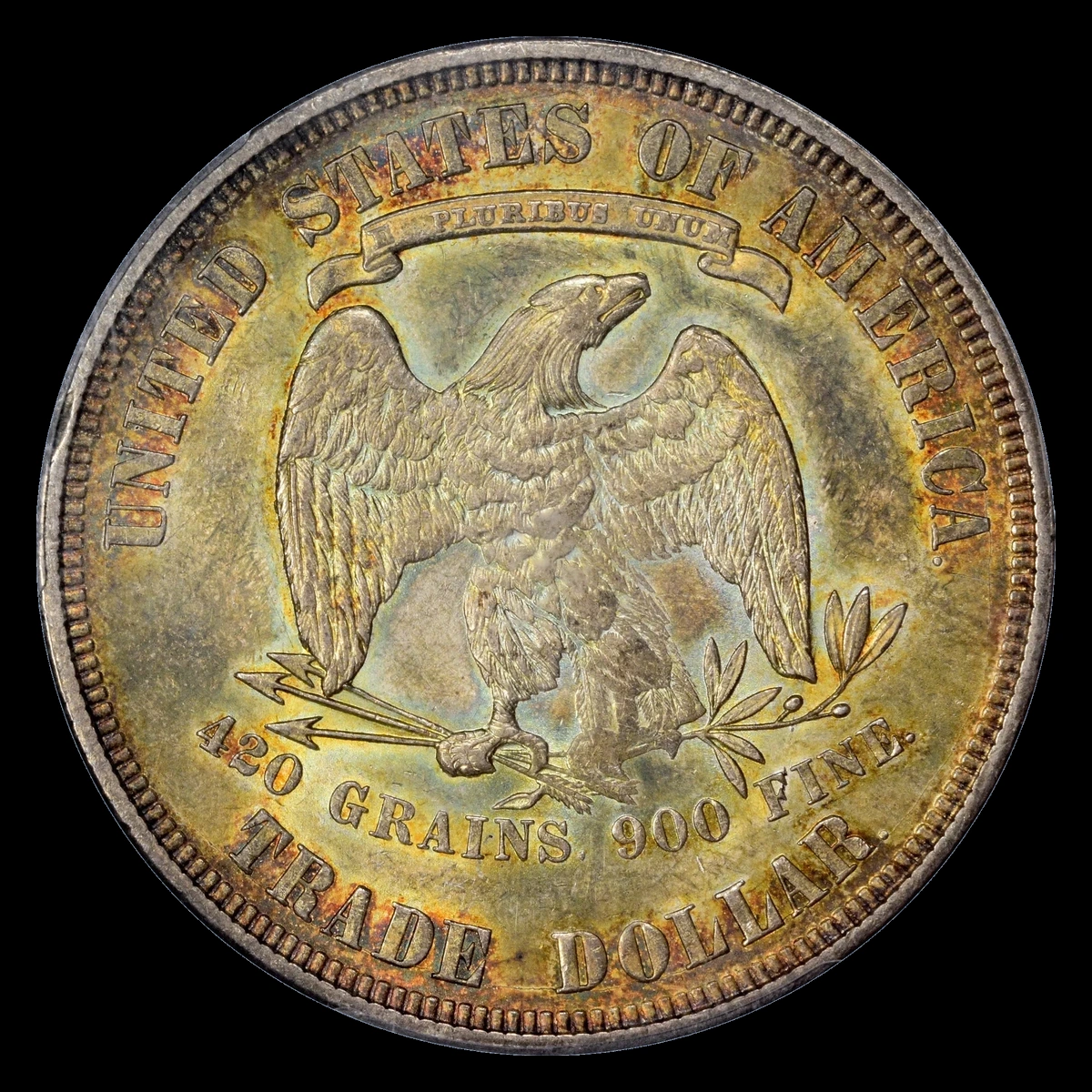
A Philadelphia dealer example has a reverse crack below TRADE. A different Carson City auction coin has a front crack through the first seven stars.
Silver entered openings in their dies and formed raised lines. The two paths belong to different coins, not one universal 1876 pattern.
How to Identify
Select the correct face and mint, then follow the whole path with the surrounding design visible. Check the center of the line rather than a single bright edge beside a possible scratch.
A ridge copied from a die rises above the silver. A cut into a finished dollar may push metal alongside it but needs a different explanation.
What It’s Worth
$200–$25,000 spans the supplied comparisons: $200–$5,000 for Philadelphia and $500–$25,000 for Carson City. The reported examples were MS62 and AU58 respectively.
Mint rarity and preservation explain much of the difference. A thin common crack does not automatically make a dollar worth more than a similarly preserved coin without it.
4. 1876 Dollar A Reported 26.99-Gram Weight: Light-Blank Candidate Error
A year article reports a Carson City dollar weighing 26.99 grams against the usual standard of about 27.2 grams. That small difference does not establish its cause.
A light blank is one possibility, but wear, filing, measurement error, or a counterfeit also need consideration. No special composition or wrong-denomination blank is proven by the report.
How to Identify
For a loose coin, repeat the measurement on a checked scale reading hundredths of a gram. Compare the diameter with 38.1 millimeters and inspect the edge grooves for removed metal.
Assess wear and the full design against an authenticated CC example. A sealed coin should stay in its holder, using documented measurements or professional examination.
What It’s Worth
$500–$15,000 is a whole-coin estimate for genuine Carson City dollars in comparable worn through lower unworn conditions, including a confirmed modest blank-weight defect. The 26.99-gram reading alone earns no separate Mint-error premium.
Filing or heavy wear can lower value instead. Establish why the coin is light before choosing a defect comparison.
Conclusion
Read the mintmark first, then match the specific branch, portrait, numeral, or crack route. The same date can contain several unrelated patterns that should remain separate.
The $55,200 record belongs to an attractive CC doubled reverse. A small raised line or slight weight difference needs its own evidence and a whole-coin comparison that includes preservation.