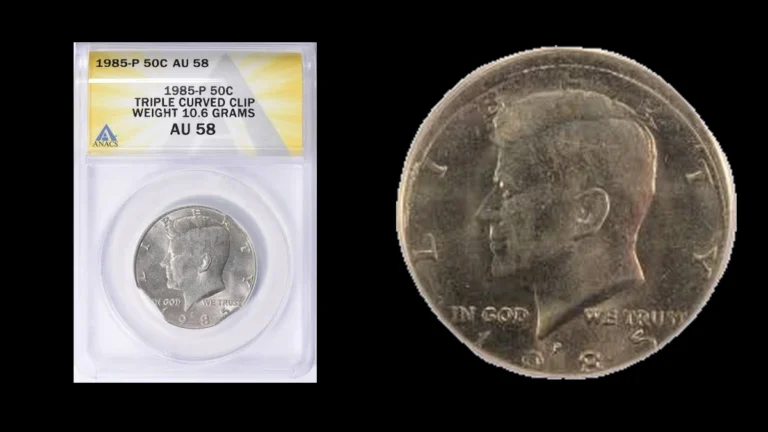
Rare 1965 Half Dollar Errors (List & Pictures)
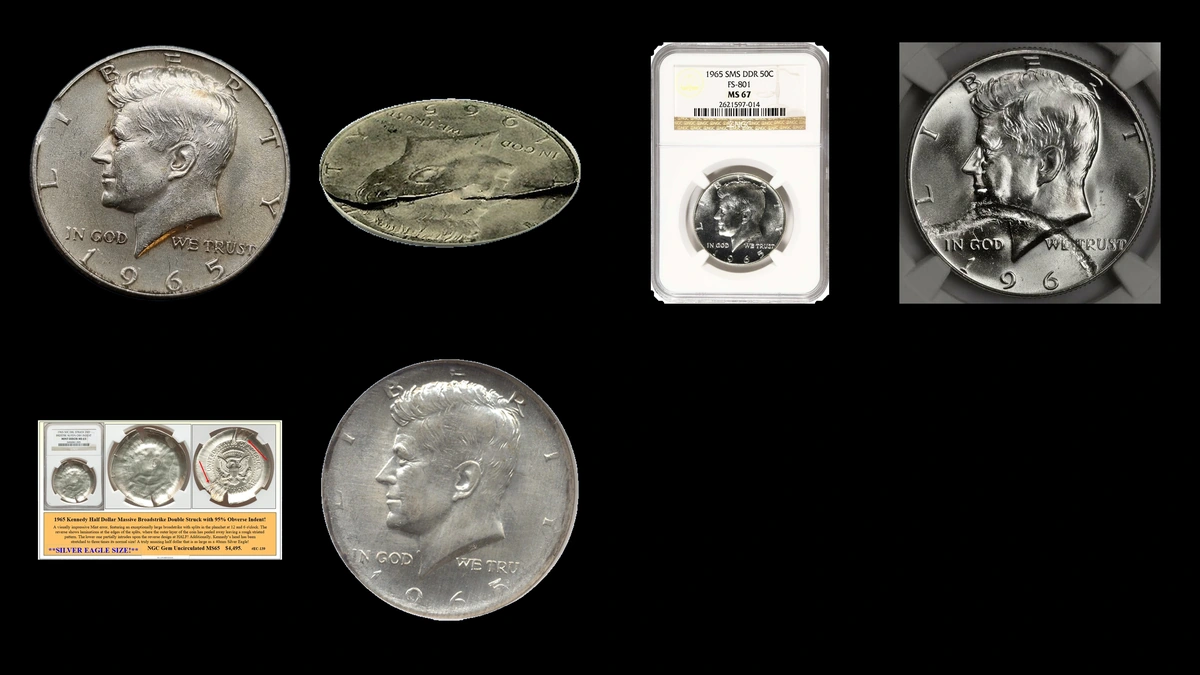
A 1965 half dollar can have a tiny doubled letter, a loose metal flap, or a shape that barely looks round. These 1965 Kennedy Half Dollar errors span roughly $50–$12,000, with a matched cap-and-mate pair bringing $8,400 in 2024.
That result covered two coins together. Start with the rim and faces, then use size and metal checks for the unusual blank reports.
| Where to look | Possible error | Typical range |
|---|---|---|
| Missing straight edge | Clipped blank | $50–$300 |
| Loose flap on the front | Clamshell lamination | $100–$400 |
| Extra edges on back letters | Doubled die | $60–$450 |
| Threadlike hollow | Twine strike-through | $150–$1,500 |
| Small coin with crowded design | Quarter blank | $1,000–$2,200 |
| Narrow strike and backward detail | Off-center brockage | $2,000–$4,000 |
| Two strikes and a large hollow | Double broadstrike with indent | $1,500–$5,000 |
| Deep cup shape | Die cap | $2,000–$8,000 |
| Full size but much too light | Unusual alloy | $2,500–$10,000 |
| Older silver mixture | Reported 90% silver blank | $3,000–$12,000 |
A normal 1965 half weighs 11.50 grams, measures about 30.6 mm, and contains 40% silver. Special Mint Set coins, called SMS coins below, need their own identification; a shiny surface alone does not establish that finish.
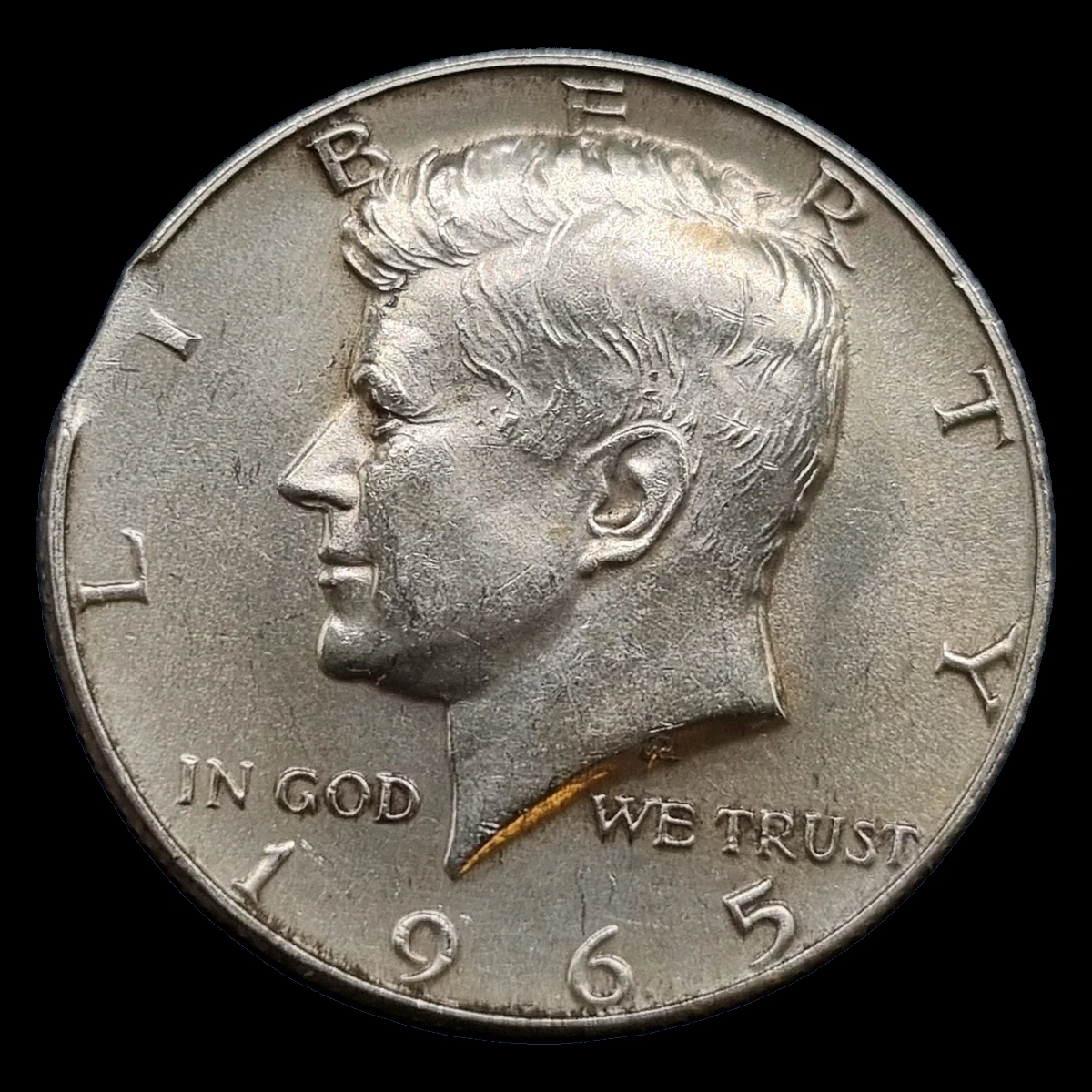
1. 1965 Half Dollar A Straight Section Is Missing: Clipped Blank Error
The reported straight clip leaves a flat gap along the edge. It began before the design was struck, when the blank was cut from an incomplete area of the metal strip.
How to Identify
Study where the design meets the missing section. A real clip should show a natural struck boundary, sometimes with a weak rim on the opposite side.
Saw marks or freshly cut lettering point toward later damage. A bright edge does not prove that the coin came from a Special Mint Set.
What It’s Worth
$50–$300 is a useful range for a genuine straight clip. A larger, clear gap and a readable date help the coin stand out.
The supporting comparison includes a $90 guide figure for a 1966 straight clip. That is a reference figure for another year, rather than a recorded sale of this 1965 example.
2. 1965 Half Dollar The Front Has a Loose Metal Flap: Clamshell Lamination Error
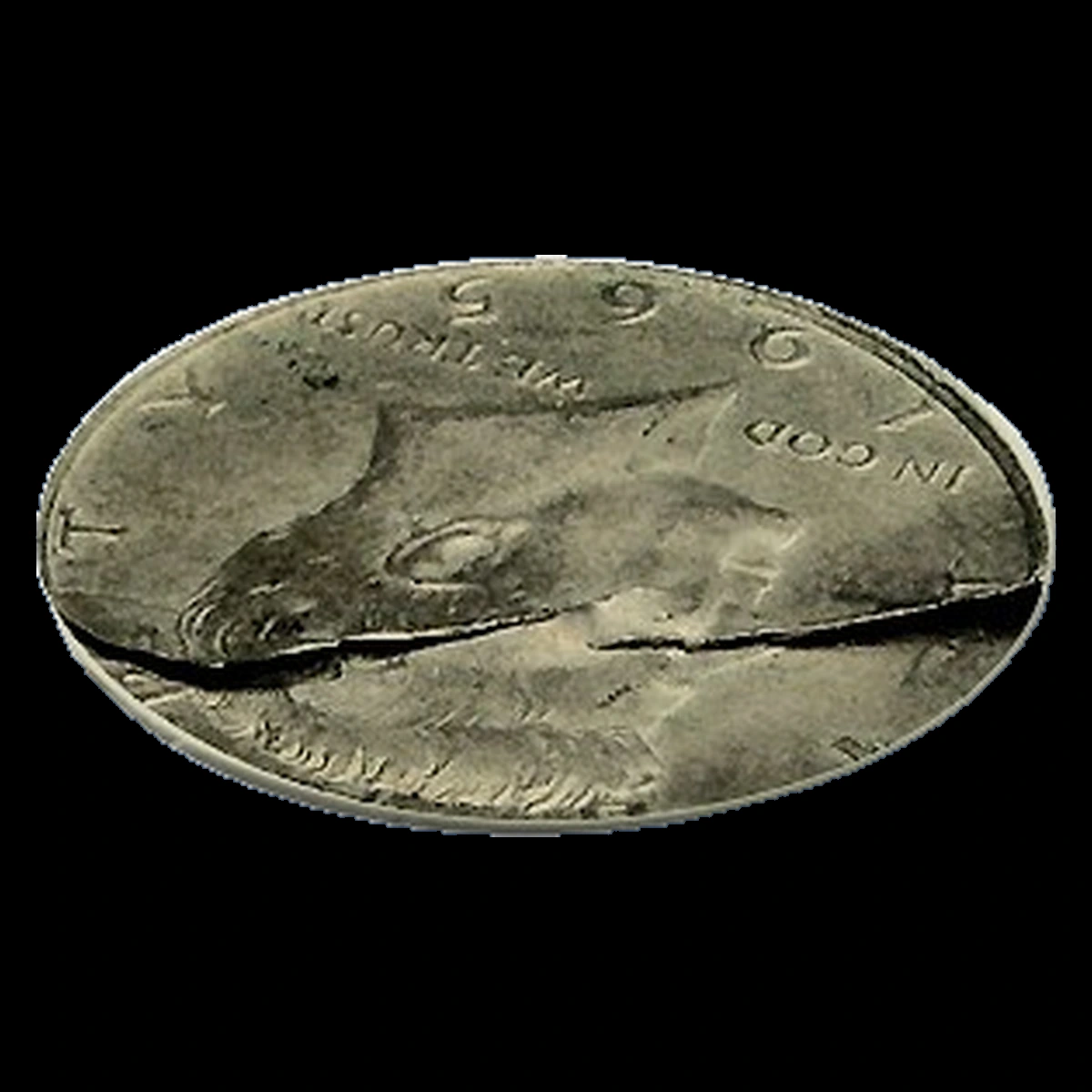
A layer of metal can separate and remain attached like a partly opened shell. The documented 1965 example has this flap on the front.
The split follows a weakness within the metal itself. Leave the flap in place, because moving it can break off the part that makes the error interesting.
How to Identify
Look for a thin sheet lifting from the coin, with a matching lower surface beneath it. A dent simply pushes metal inward and does not create the same natural separation.
An attached flap may leave the coin close to its normal weight. Do not squeeze it shut or try to open it farther.
What It’s Worth
$100–$400 covers a practical range for this type. Heritage sold the NGC MS64 example for $144 in July 2021.
The size of the flap and how well it remains attached matter more than a dark line alone. A clear, stable split is easier for a buyer to appreciate.
3. 1965 Half Dollar Back Letters Show Extra Edges: Reverse Doubled Die Error
Check the wording around the eagle for rounded extra contours. A doubled die carries a doubled image on the striking tool, so the same extra detail appears on coins made with that tool.
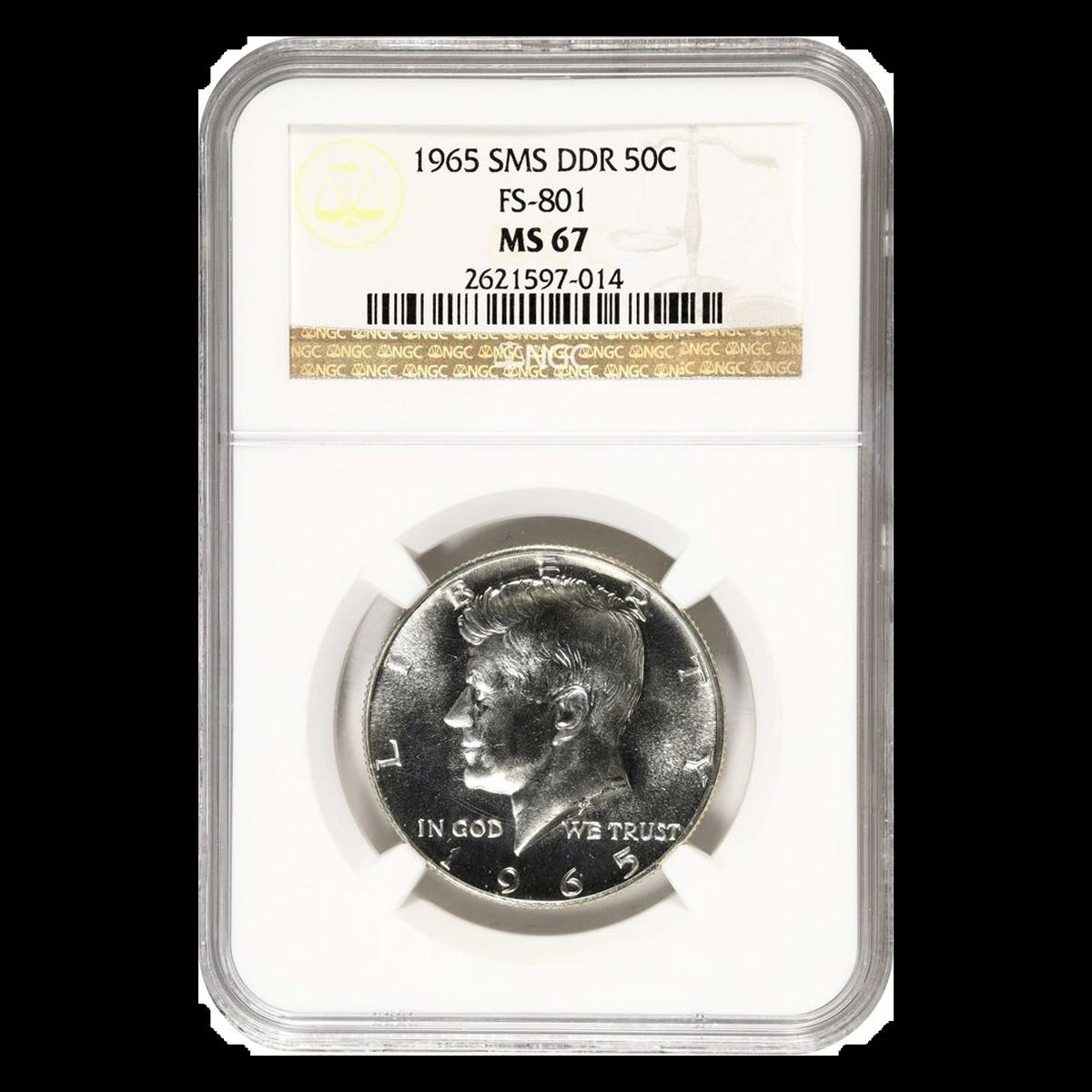
Reports cover regular 1965 coins and separate SMS examples. The recognized SMS FS-801 variety includes doubling in stars and lettering.
How to Identify
On a regular coin, compare UNITED STATES OF AMERICA and HALF DOLLAR with a matching reference. For an SMS candidate, use the SMS pattern rather than treating all 1965 doubling as FS-801.
True doubled detail can have rounded separation or split corners. Flat, shelf-like edges can come from movement during the strike and should not receive the same variety label.
What It’s Worth
$60–$450 is a working range across the supplied reverse-doubling examples. The PCGS record for SMS FS-801 lists a SP66 sale of $282 in January 2019.
That result belongs to the named SMS variety and grade. A regular coin needs its own matching pattern before the same comparison becomes useful.
4. 1965 Half Dollar A Threadlike Hollow Crosses the Portrait: Twine Strike-Through Error
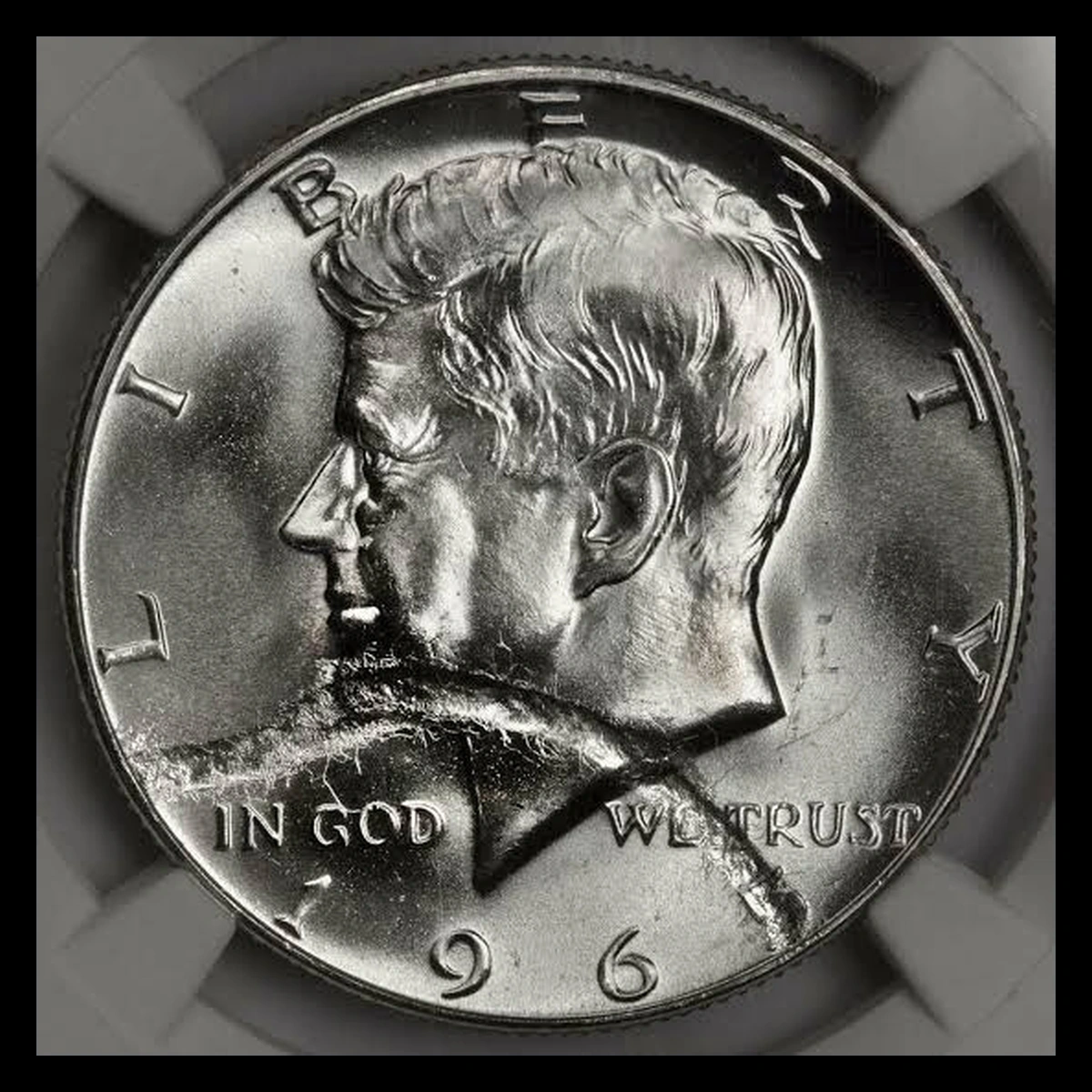
A strand caught between the coin and die can leave a narrow impression instead of normal design. A published 1965 example shows this kind of interruption across Kennedy’s portrait.
How to Identify
Follow the hollow under magnification and look for texture from the trapped material. A later scratch tends to cut through the finished surface and may push a ridge of metal to one side.
Use the specific name “twine” only when the photographed texture supports it. The pictured MS67 grade does not by itself identify an SMS coin.
What It’s Worth
$150–$1,500 is an estimated range for a clear 1965 strand strike-through. The supplied record does not give a sale price for the pictured MS67 coin.
A 1992-D half struck through a metal fragment sold for $336 in July 2021 in MS64. It offers a broad comparison, although the year, metal, and trapped object differ.
5. 1965 Half Dollar The Design Is Crowded onto a Small Coin: Quarter Blank Error
On the documented quarter-blank error, the date and eagle survive, but HALF DOLLAR falls beyond the small edge. The coin is slightly oval and retains some edge grooves.
A quarter blank entered the half-dollar press by mistake. The larger half-dollar dies could not fit their complete design onto it.
How to Identify
A clad quarter blank starts at about 5.67 grams and 24.3 mm across. Striking can stretch its outline, so compare the weight, metal layers, and surviving design together.
A cut-down half dollar can also look small. It will not naturally match the quarter blank’s copper-nickel construction and struck edge.
What It’s Worth
$1,000–$2,200 suits a genuine 1965 half struck on a clad quarter blank. A PCGS MS65 example brought $1,560 at Heritage in January 2018.
A readable date and enough design to identify the half-dollar dies make the error easier to collect. Heavy damage after striking lowers its appeal.
6. 1965 Half Dollar Only a Narrow Area Was Struck: Off-Center Brockage Error
The recorded SMS example is about 85% off center, leaving only a small struck area. Part of the date, motto, and lower portrait still identify the coin.
Its other face carries a sunken, backward image called a brockage. Another struck coin blocked the die and pressed its design into the new blank.
How to Identify
Check both faces of the same narrow struck area. The normal design should pair with a matching backward impression on the opposite side.
A plain hollow is an indent, not enough by itself to prove a brockage. The SMS identification also belongs to the authenticated example, rather than every shiny off-center coin.
What It’s Worth
$2,000–$4,000 is a practical range for a comparable combination. The PCGS SP63 example sold for $2,640 in May 2022.
Off-centering and brockage are two features of one coin. Value the whole piece rather than adding two separate error prices.
7. 1965 Half Dollar Two Strikes Share a Wide, Indented Coin: Double Broadstrike Error
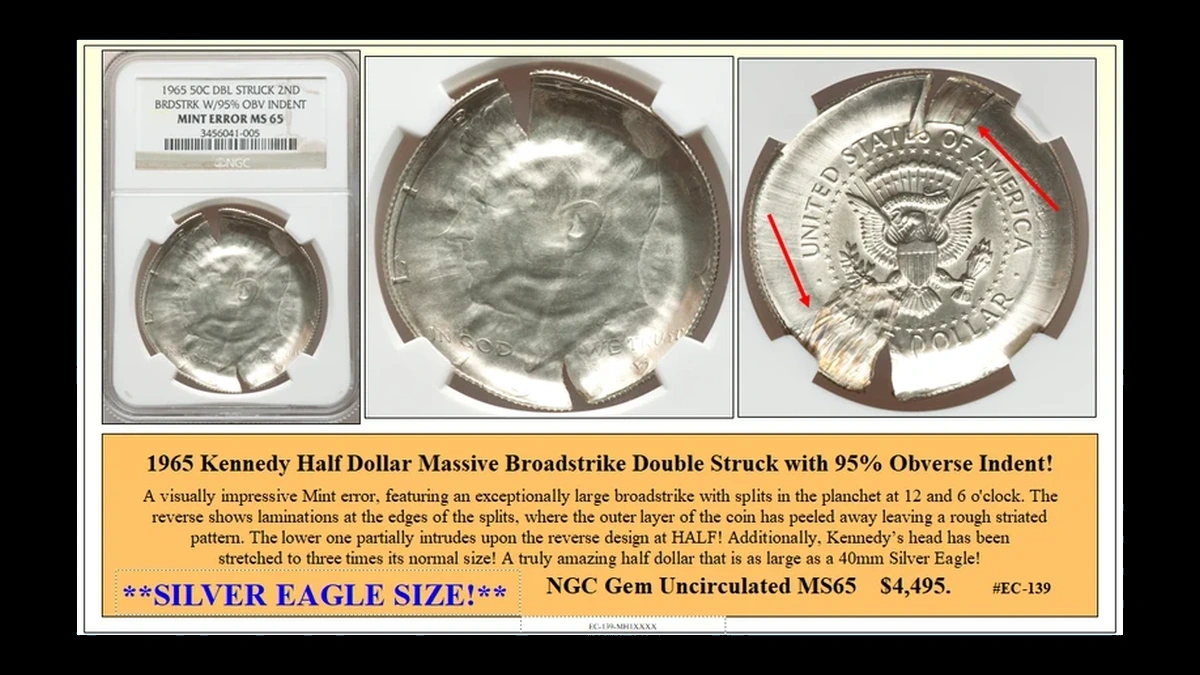
This reported combination includes two strikes, a broad second strike, and an indent across roughly 95% of the front. The broad shape formed when the collar failed to contain the expanding metal.
The indent came from another blank or coin obstructing the strike. These features need separate visible evidence on the same piece.
How to Identify
Locate surviving traces of both strikes, then inspect the enlarged outline and great hollow on the front. A wide coin alone does not establish that it was struck twice.
Within the hollow, plain surface supports an indent. Backward design would instead show that a struck coin transferred a brockage image.
What It’s Worth
$1,500–$5,000 is an estimated range for a well-preserved single coin with this combination. The pictured NGC MS65 example has no supplied sale price.
A related 1965 pair sold for $5,175 in February 2007. It contained an indented double strike and a separate expanded brockage, so its total should not be assigned to one coin.
8. 1965 Half Dollar The Edge Rises into a Cup: Obverse Die Cap Error
A die cap starts when a struck coin sticks to a die and takes more blows. Repeated strikes push its edge upward, turning the coin into a cup.
The supplied NGC MS64 example retains Kennedy’s portrait inside a deep cap. Its reverse shows a stretched brockage image.
How to Identify
View the coin from the side as well as above. The rising wall, retained design, and stretched opposite face should fit repeated pressure in the press.
Hand-bent coins can have a rough cup shape without that connected pattern. Do not squeeze the wall or force the piece into a holder.
What It’s Worth
$2,000–$8,000 is a working range for a single substantial 1965 cap. Depth, surviving portrait detail, and condition make a large difference.
A different matched cap-and-mate pair, graded PCGS MS64–MS65, sold for $8,400 in August 2024. That is a two-coin result, not a sale of the pictured NGC cap alone.
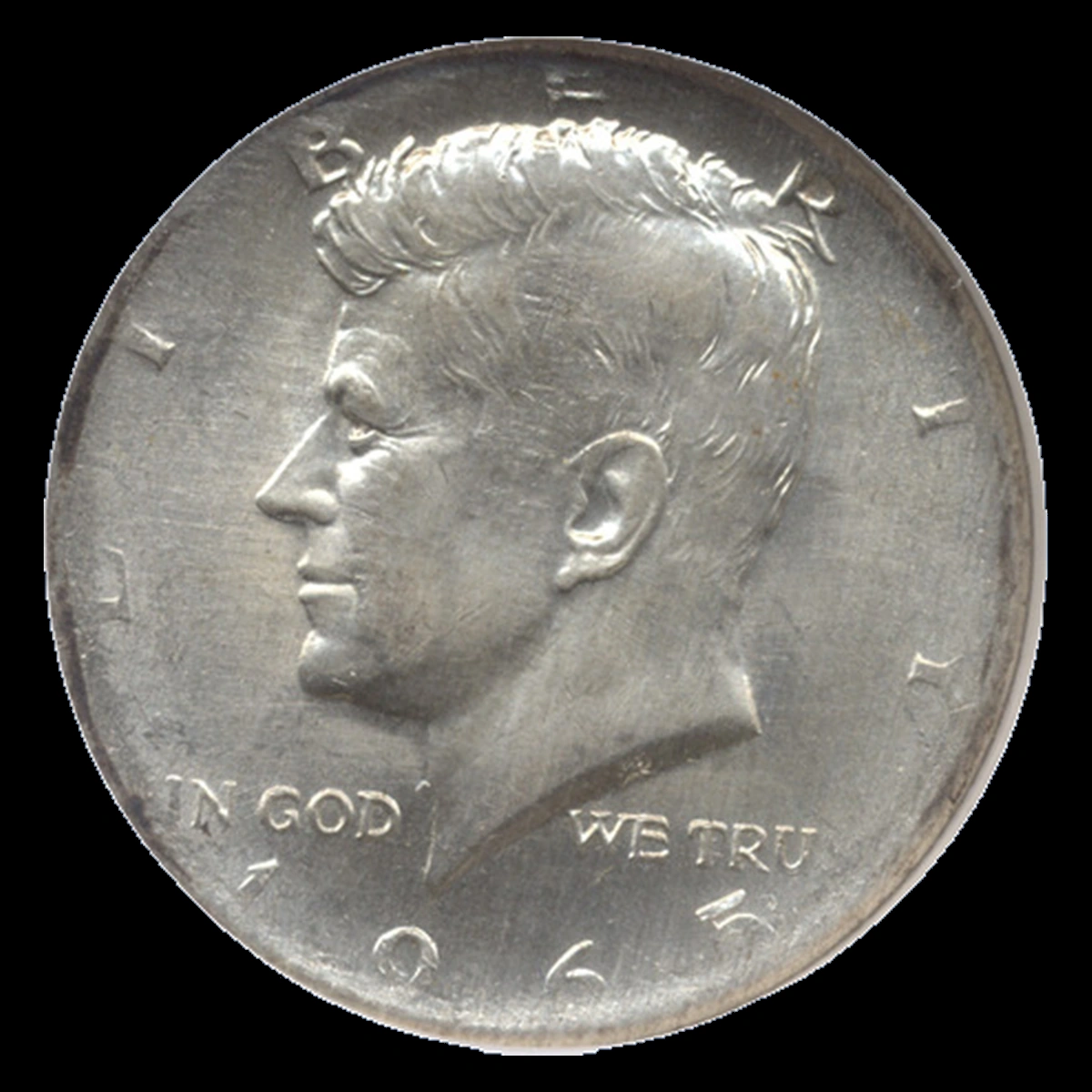
9. 1965 Half Dollar A Full-Size Coin Weighs Only 7.62 Grams: Unusual Alloy Error
The reported 7.62-gram half is full size but much lighter than normal. Published tests gave a mixture of about 25% silver and 75% copper.
That report describes an unusual alloy, not an identified foreign blank. It also does not establish that the Mint deliberately made an experimental coin.
How to Identify
Confirm the weight on a reliable scale and examine both faces and the edge for removed metal. Grinding, plating, or chemical damage can change the appearance or weight of an ordinary coin.
A specialist’s metal testing is central to this identification. A reading from the surface alone may not describe the metal throughout the coin.
What It’s Worth
$2,500–$10,000 is an estimated collector range for an authenticated unusual-alloy piece. The published discovery report provides the weight and alloy claim, rather than a completed auction result.
For scale, a 1974 half on an identified Taiwan 5-dollar blank sold for $2,880 in September 2023 in PCGS AU55. Its known foreign blank makes it a different kind of wrong-metal comparison.
10. 1965 Half Dollar The Metal Matches the Older Silver Issue: Reported 90% Silver Blank Error
Half dollars changed from 90% silver in 1964 to 40% silver in 1965. The reported transition error would result from an older blank remaining in the production flow.
Both versions are about the same diameter and have grooved edges. Their weight and metal mixture provide more useful clues than a bright silver color.
How to Identify
The older 90% silver blank has a target weight of 12.50 grams, compared with 11.50 grams for the normal 1965 half. Check that the date is original and the surfaces have not been altered.
Professional authentication should combine weight with suitable metal tests. A white-looking edge alone cannot establish this rare blank mix-up.
What It’s Worth
$3,000–$12,000 is an estimated range for an authenticated example of this reported transition error. Coin World’s Kennedy half coverage discusses the older-silver-blank report.
The supplied comparison is a 1965 Washington quarter on 90% silver, which sold for $5,880 in January 2023 with light wear and cleaning noted by NGC. It is a different denomination, not a recorded sale of a 1965 silver half-dollar error.
Conclusion
Begin with the feature you can actually see: missing metal, doubled back letters, an interrupted portrait, or an abnormal shape. Then check whether the reference describes a regular coin or an SMS issue.
Small size and unusual metal need measurements as well as photographs. Keep pair prices attached to both coins, and preserve loose flaps and raised cap walls exactly as you find them.