Rare 1825 Penny Errors (List & Pictures)
An unworn N-2 with a reverse crack sold for $12,650 in September 2011. Its preservation explains much of that result among 1825 penny errors, whose estimated whole-coin values span $35–$15,000.
Compare displaced designs and reverse alignment before studying repeated letters, a recessed curve, and raised die failures. Normal copper Coronet cents weigh 10.89 grams and measure about 28 mm; those measurements support basic identity without identifying a particular error.
1. 1825 Penny The Design Shifts toward the Upper Left: Off-Center Strike Error
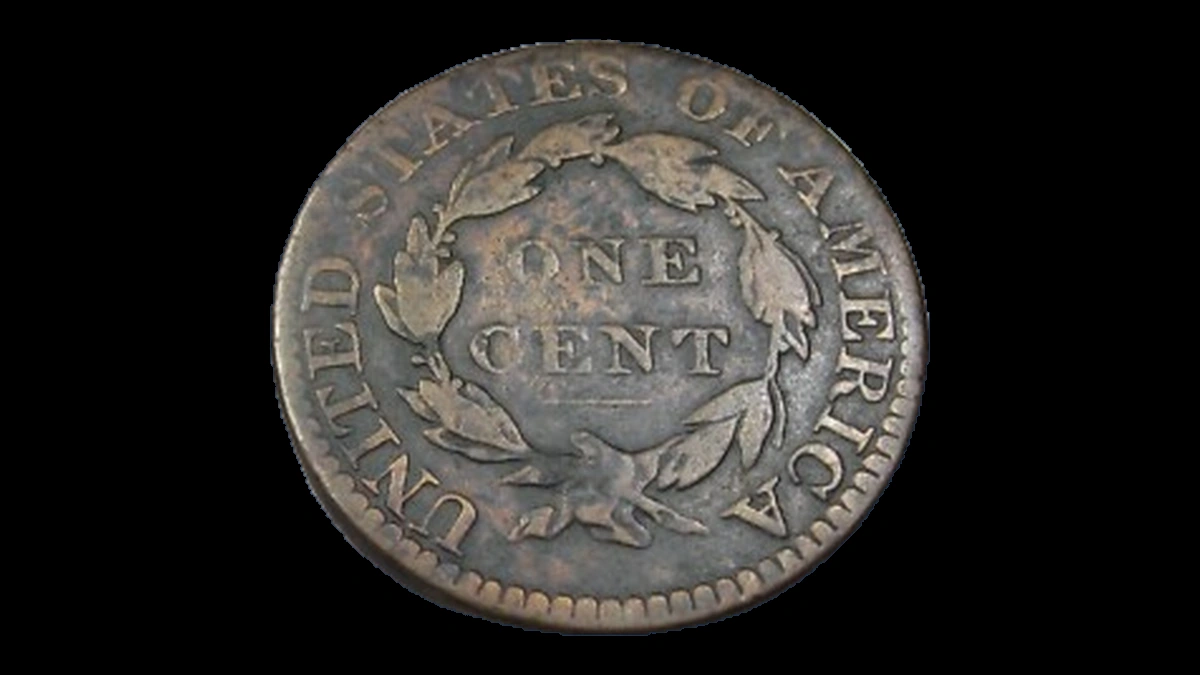
The cataloged coin was struck about 20% off center toward 11 o’clock on the front. Parts of UNITED and AMERICA missed the available metal on the reverse.
It also has corrosion and a scrape near ONE’s E. These are later condition problems alongside the original misplaced strike.
How to Identify
Compare both complete faces and relate the upper-left front shift to the missing reverse letters. The original bare crescent should remain metal that never received design.
Grinding, sharp edge cuts, or flattened finished lettering can imitate missing detail. Record the corrosion and scrape separately instead of explaining them as additional strike effects.
What It’s Worth
Similar worn pieces have an estimated range of $250–$1,500, while cleaner readable-date examples with stronger detail may fit $1,500–$5,000. Displacement is not priced by a fixed amount per percentage point.
The documented coin sold for $322 in April 2002. ANACS described VG Details, Net Good 4, preserving both its heavy wear and additional damage in the comparison.
2. 1825 Penny The Wreath Leans about Half a Right Angle: Rotated Dies Error
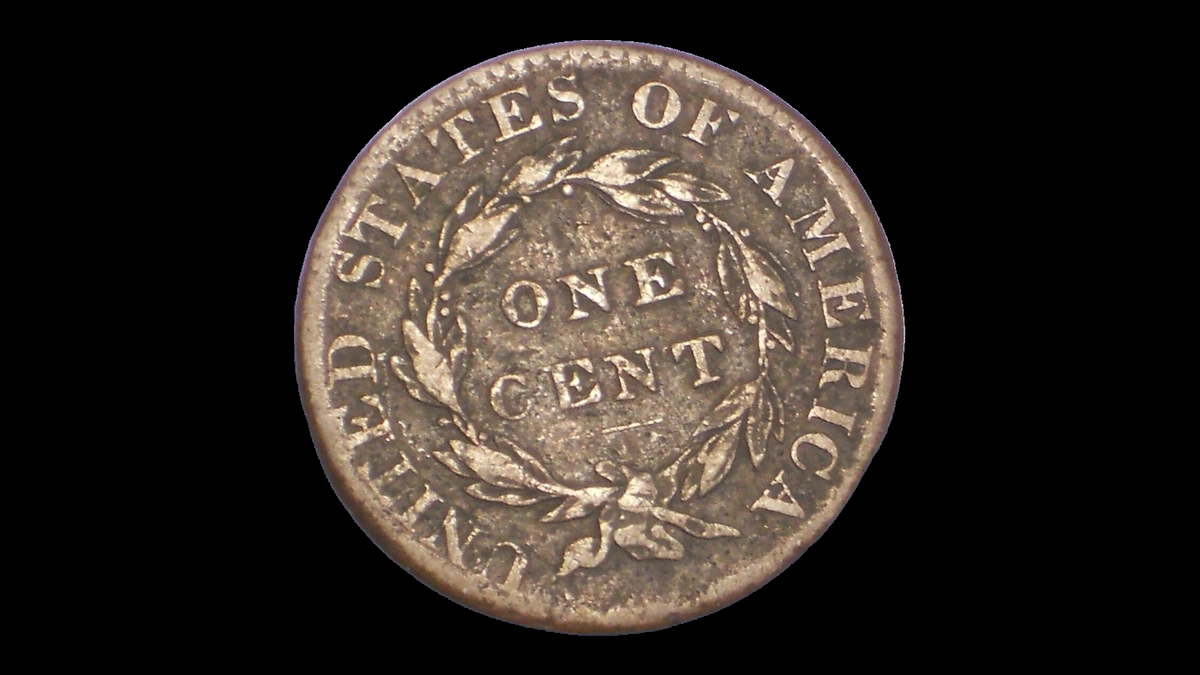
A collector reports about 45 degrees of rotation on an N-6 graded AU50 Brown. The dies were turned relative to one another, so the reverse finishes tilted when the front is flipped correctly.
The report supplies no clockwise or counterclockwise direction. That part of the description must come from the actual coin.
How to Identify
Hold Liberty upright against a vertical guide and flip top to bottom without twisting. Photograph the wreath before adjusting your grip and measure its central axis.
Repeat the movement to rule out accidental turning. This relative tilt differs from two overlapping sets of letters caused by repeated strikes.
What It’s Worth
Worn examples with a clear rotation are estimated at $75–$600; attractive lightly worn or unworn coins may fit $600–$3,000. The collector’s AU50 N-6 has no supplied sale amount.
A widely rotated 1852 cent graded NGC MS65+ Red-Brown sold for $2,350 in November 2014. That stronger unworn comparison is not a direct price for a more worn 1825.
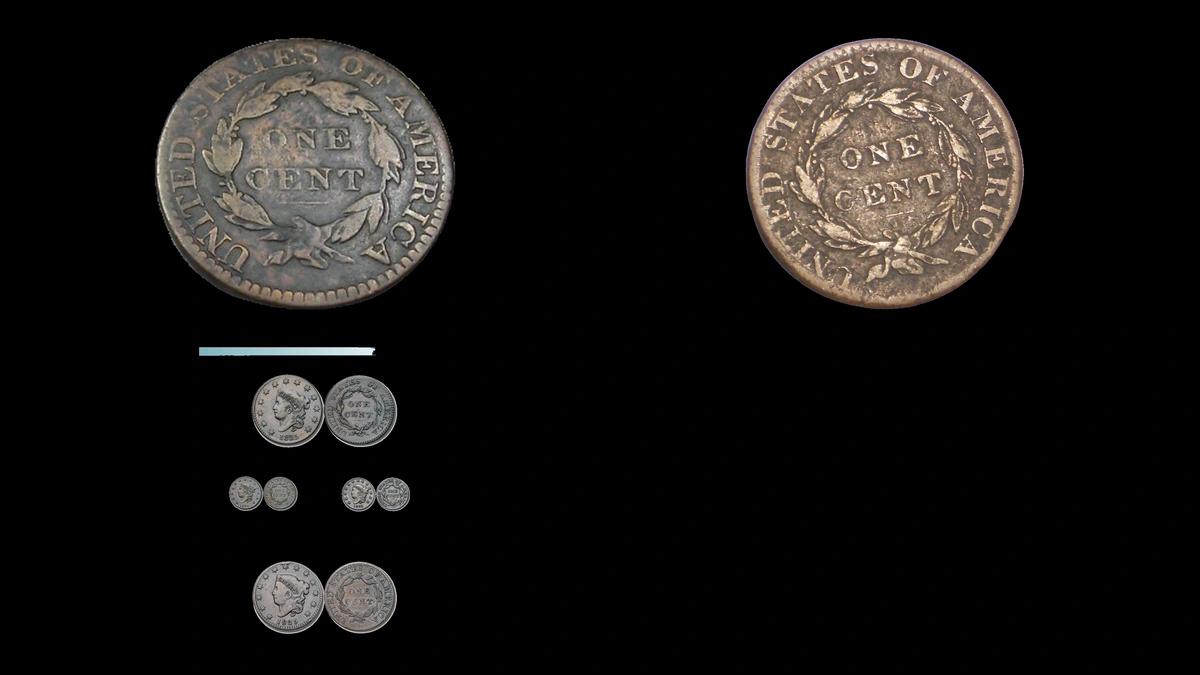
3. 1825 Penny Reverse Letters Occupy Two Close Positions: Double Strike Error
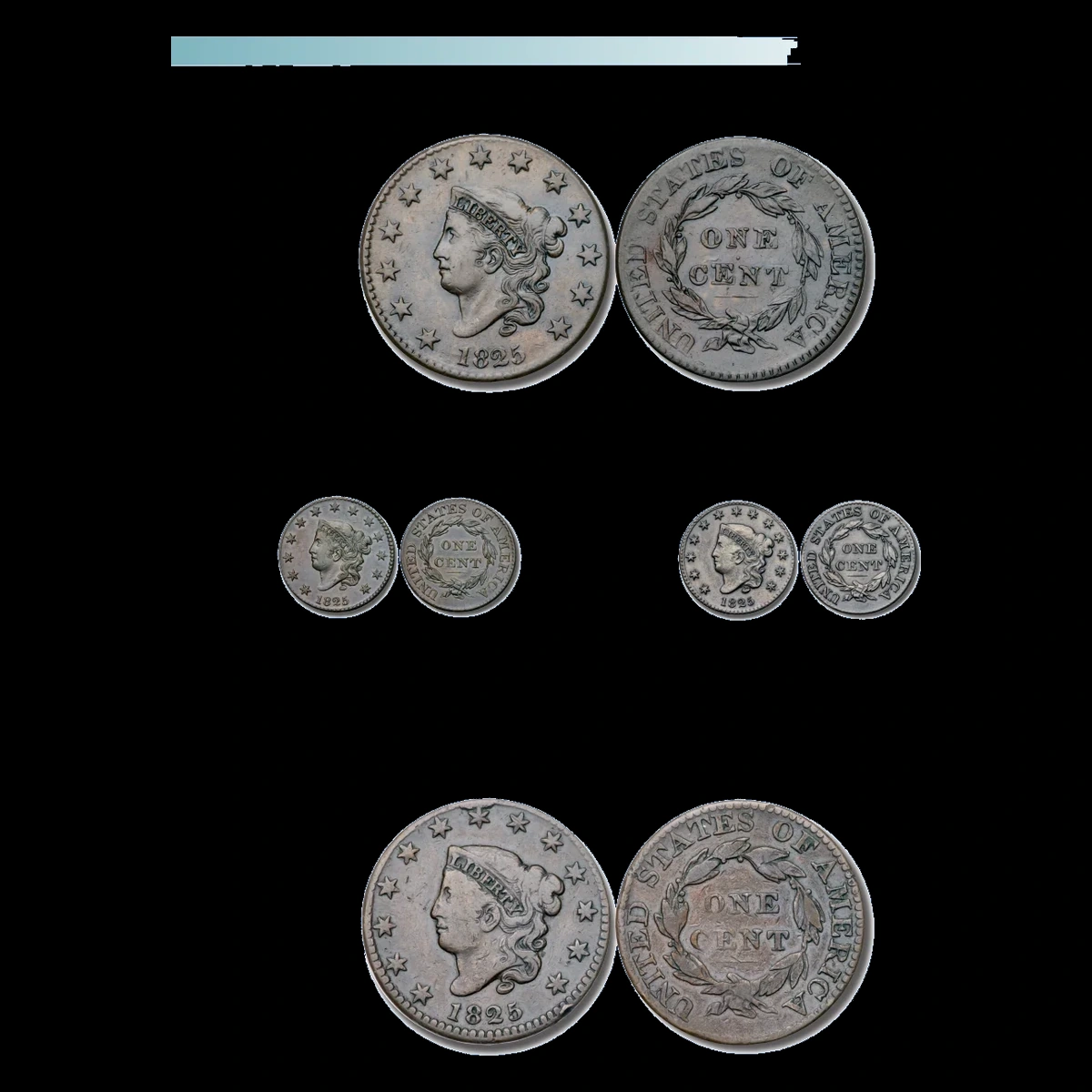
The N-3 catalog example has about 5 degrees of clockwise overlap, particularly visible in ONE CENT. A separate N-9 shows a smaller counterclockwise shift at the A in STATES, with the earlier left upright overlapping the later right upright.
These descriptions identify two strikes, while the fronts lack the same rotated doubling. A suggestion that N-3 helped create a mirror impression on another blank does not establish a brockage on this coin.
How to Identify
Use ONE CENT for the N-3 clockwise pattern and the A in STATES for N-9’s counterclockwise overlap. Several repeated letters should agree with the same small movement.
Compare real displaced letter shapes rather than flat shelves along one edge. Inspect the front as well, without requiring it to show equivalent rotated details.
What It’s Worth
Circulated examples have an estimated range of $400–$2,000, with strong lightly worn pieces around $2,000–$7,000. Clarity and original surfaces determine the useful comparison.
N-3 was cataloged VF20, while N-9 was graded NGC AU58; neither receives a completed sale price here. N-9’s curved front indentation belongs to the same coin and should not add another full estimate.
4. 1825 Penny A Curved Depression Follows Liberty’s Profile: Struck Through Material Error
The NGC AU58 N-9 has a curved indentation beside Liberty’s profile described as mint-made. Material between the blank and die blocked normal design formation in that area.
The catalog does not identify the material. A curved shape alone cannot establish thread, wire, or hair.
How to Identify
Light the curve from opposing sides to confirm a recessed impression beside the profile. Sharp scraping, a shiny cut, or pushed-up metal along a groove can indicate later damage.
Keep the whole portrait in the photograph and compare the boundary with neighboring design. The reverse overlap is a separate supporting feature of this particular N-9, not an explanation of the front curve’s material.
What It’s Worth
Worn examples with clear strike-through evidence are estimated at $75–$600; attractive lightly worn pieces may fit $600–$4,000. These values concern complete coins.
The cataloged N-9 also has a double-struck reverse, with no separate sale assigned to its indentation. A small curve on an ordinary worn cent cannot inherit the compound coin’s full comparison.
5. 1825 Penny Raised Lines Circle the Stars or Reach the Rim: Cracks and Cud Error
N-4 has a crack beginning at the top of the date’s 1 and running clockwise through the stars toward the bottom of 5. N-2 instead has a reverse crack from the border toward the wreath stem.
On N-10, a rim-connected raised break covers star seven’s outer point. That cud records a larger opening in the die than the narrow cracks on the other varieties.
How to Identify
For N-10, inspect the edge for folded copper before comparing the patch where the star point should be. Side lighting should show metal raised into the area of missing die detail.
Trace N-4’s long front route and N-2’s shorter reverse route separately. Their lines should rise above intact copper rather than cut into a completed design.
What It’s Worth
Circulated cracks and small breaks have an estimated whole-coin range of $35–$800. Highly preserved examples may reach $800–$15,000, largely because of the complete coin’s condition.
An N-2 graded PCGS MS64 Brown sold for $12,650 in September 2011. Its unworn preservation prevents treating that amount as a standalone price for a fine crack on a worn cent.
Conclusion
On an 1825 cent, height and orientation help separate the clues: the profile curve sinks into the surface, die cracks rise from it, and repeated reverse letters occupy distinct positions. A rotated reverse needs a controlled flip instead.
Match the precise variety and preserve condition qualifications before selecting a price. The N-9’s indentation and double strike share one coin, while the exceptional N-2 sale reflects much more than its reverse crack.