Rare 1852 Quarter Errors (List & Pictures)
A matching date does not make two early quarters equally valuable. Among 1852 quarter errors, a Philadelphia repunched date occurs on circulation coins and an exceptionally rare Proof, a specially prepared collector issue.
The Proof brought $176,000 in May 1998, while the supplied whole-coin estimates span $150–$200,000. Examine the numerals, then test the eagle’s orientation and border spacing; those checks distinguish repeated punches, rotation, and a slightly shifted reverse without counting one coin’s features as separate prices.
1. 1852 Quarter Earlier Strokes beneath the Date: Repunched Date Error
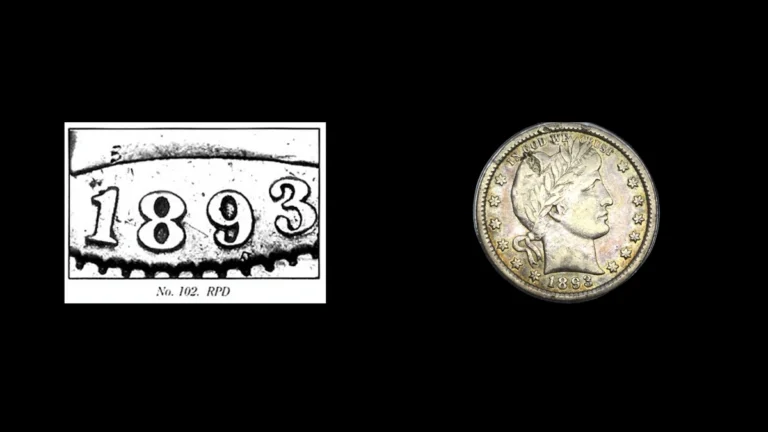
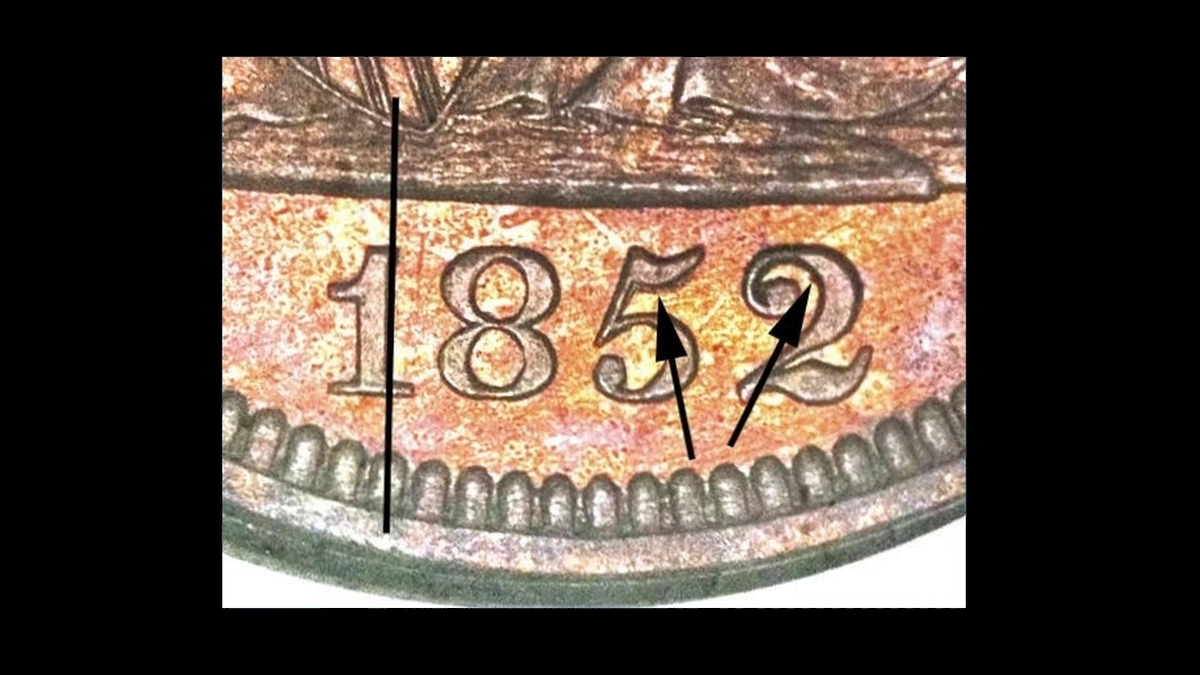
The variety called 1852/52 has traces of earlier numeral positions beneath the finished date. Its relationship to the shield above it helps identify the die even when wear makes the extra strokes difficult to see.
During preparation, the date was punched into the die more than once. The completed tool then transferred the combined numeral outlines to each blank in the press.
How to Identify
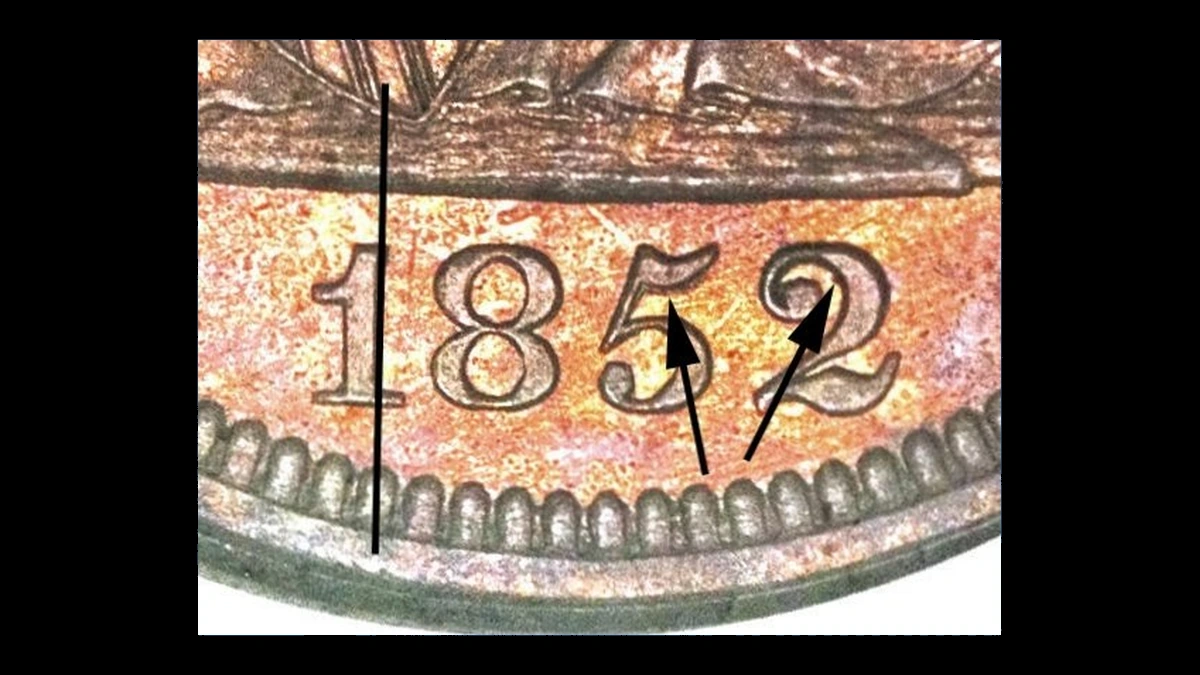
Take one photograph that includes both the complete date and the shield’s vertical lines. On the identified variety, the right edge of 1 falls near lines six and seven; the other ordinary front die places it farther left, near line five.
Enlarge 5 and 2 to locate the extra strokes, then compare their positions with an attributed example. The described Proof also shows repunching at 8, so its diagnostic account refers to 852.
Look for additional raised numeral contours instead of cuts through the digits. A scratch crossing a number does not represent an earlier punch simply because it lies near an expected stroke.
The date pattern identifies a die, but does not by itself identify a Proof. The complete strike, surface finish, and recognized attribution require separate examination by someone familiar with early Proofs.
That distinction is particularly important on shiny examples. Polishing an ordinary circulation coin can create reflections while damaging the original surfaces.
What It’s Worth
$150–$200,000 is the combined whole-coin estimate, spanning very different kinds of 1852/52 quarters. Circulation examples are estimated at $150–$8,000, while the exceptionally rare Proof falls in a supplied $100,000–$200,000 range.
Greg Johnson’s 1852/52 study records $176,000 in May 1998 and $138,000 in August 2008 for the Proof. These successive results concern the rare complete coin, not a price attached independently to the repeated numerals.
A worn circulation strike shares the date feature without sharing the Proof’s market. Establish manufacture and preservation before selecting either range.
2. 1852 Quarter An Eagle That Finishes Sideways: Rotated Reverse Error
Two reported Philadelphia circulation examples combine the repunched date with a substantially turned reverse. One has a 90-degree rotation and another about 45 degrees.
A die can turn away from its normal orientation while remaining centered over the blank. Its eagle consequently points in the wrong direction relative to Liberty, even if both designs fit normally inside their borders.
How to Identify
Place Liberty upright and flip the coin top to bottom, keeping your fingers at the same points. In normal American coin alignment, the eagle will then be upright too.
Repeat that controlled flip to see whether the same tilt remains. A sideways turn from left to right uses a different axis and can make an ordinary coin appear incorrectly aligned.
A quarter-turn rotation leaves the eagle sideways, while a roughly 45-degree rotation leaves it diagonal. Keep the front’s starting orientation and the turning direction in your photographic record.
Confirm the 1852/52 date pattern as a separate step because the supplied rotation reports concern that variety. They do not establish the same rotations on Proofs or New Orleans quarters.
Separate listing photographs are often independently straightened, hiding the original relationship. A holder should stay sealed; the alignment can be assessed through it by a specialist.
What It’s Worth
$300–$6,000 is the estimate for circulation examples with these substantial rotations. Wear, original surfaces, and readable date diagnostics affect where an individual coin might fit.
The packet supplies no realized price for either reported rotation. This range values the combined coin, so an additional repunched-date estimate should not be added to it.
3. 1852 Quarter Less Space above the Eagle: Reverse Die Misalignment Error
The cataloged rare Proof has a slightly high reverse image, with the design displaced toward 12 o’clock. This changes the spacing around the eagle without describing an angular turn.
The auction description identifies the coin as NGC PR65. That grade applies to the specially made Proof and its preservation, while the slight misalignment describes one feature of its reverse.
How to Identify
Use a straight-on photograph with the entire reverse rim included. Compare the space above the eagle with the space below the denomination, looking for the described upward shift.
A tilted camera or clipped photograph can change the apparent border widths. The comparison is more useful when the coin is square to the camera and both edges remain visible.
Inspect the front independently to determine how its centering compares. A back-only catalog observation does not establish that a displaced blank left both faces off center.
Finally, match the complete Proof through its grading record and photographs. An uneven border on an unrelated circulation quarter cannot identify this rare object.
What It’s Worth
$100,000–$200,000 is the supplied whole-coin estimate for the rare Proof with the slight reverse shift. Its rarity, quality, and documented history account for that scale of value.
The Proof’s repunched date and high reverse belong to one coin. Neither the range nor its historical auction results should be added to another figure as if the shift were sold separately.
Conclusion
Use the shield to locate the date, a controlled flip to test rotation, and a full-rim photograph to judge centering. Each observation answers a different question about how the coin was made.
The major price distinction is between circulation manufacture and the rare Proof. Shared date strokes do not erase that distinction, and several features on one specimen still require a single whole-coin valuation.