Rare 1999 Dollar Errors (List & Pictures)
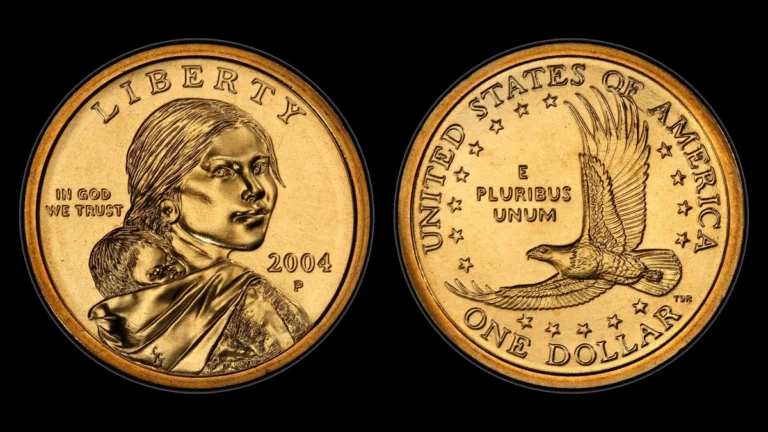
An Anthony dollar struck on a Sacagawea blank sold for $16,800 in January 2020. The estimated range across 1999 Susan B. Anthony dollar errors is $50–$25,000.
Inspect lettering and the outline before tracing repeated designs or checking metal. A golden surface can involve a wrong production blank, an experimental alloy, or later plating, so those possibilities require separate evidence.
1. 1999 Dollar Extra Front Lettering Outlines: Proof Doubled Die Error
A doubled front die is reported for 1999-P Proofs, the specially prepared collector coins. The P is normal for this year’s Proof and does not itself identify an error.
The report concerns lettering and date details carried by the stamping tool. It does not establish that every thick-looking letter is part of the variety.
How to Identify
Confirm the finish, then magnify LIBERTY and the date while moving glare away. Match several raised extra strokes with a documented Proof pattern.
Flat ledges beside reduced letter edges can result from movement during striking. A reflection that changes with the lamp is also different from a fixed repeated design.
What It’s Worth
$50–$250 is the estimated range for an identified Proof doubled-die example. No specific sale is supplied, and fingerprints or cleaning can reduce value even after attribution.
2. 1999 Dollar A Curved Gap in the Outline: Clipped Blank Error
A major curved clip on a documented Philadelphia dollar leaves it weighing 7.00 g. ANACS graded it MS63, an unworn coin with noticeable marks.
The blank cutter overlapped an existing hole before the incomplete disc was struck. Denver clips are also reported, but the Philadelphia specimen’s measurement does not describe them all.
How to Identify
Follow the rim into both ends of the gap and look for naturally weakened or stretched details. Opposite-rim weakness can support an original clip.
Compare weight with the normal 8.10 g and inspect the boundary for saw grooves or filing. A later cut can also make a coin light, so weight cannot establish timing alone.
What It’s Worth
$75–$750 is the estimated range for authentic clips. The supplied 7.00 g example provides a physical comparison, without a quoted sale price.
The missing area, readable identification, and condition of the remaining coin guide the comparison. Do not require every genuine clip to share that one weight.
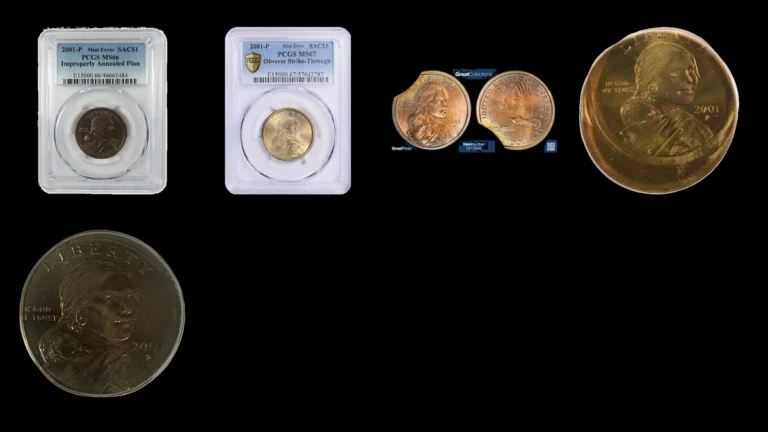
3. 1999 Dollar Full Design within an Expanded Border: Broadstrike and Type One Blank Error
A blank can spread beyond its normal width when the collar fails to contain it. A broadstrike retains the complete design inside that expanded outline.
Philadelphia examples include NGC MS67 coins and a separate NGC AU58 on a Type One blank. Type One means the blank had not received its preliminary raised rim; it describes preparation before the strike.
How to Identify
Trace the full outer design on both faces before comparing width with the normal diameter near 26.5 mm. Missing outer letters point toward an off-center strike instead.
Examine widened metal for an original design rather than later hammering. A wide outline does not by itself establish Type One preparation, and reported Denver broadstrikes do not inherit the Philadelphia grades.
What It’s Worth
$100–$1,500 is the estimated broadstrike range. The degree of spread and preservation matter, while a separately authenticated Type One blank can add interest to the complete coin.
Do not add an entire blank-type estimate to a broadstrike estimate. They describe connected aspects of one object.
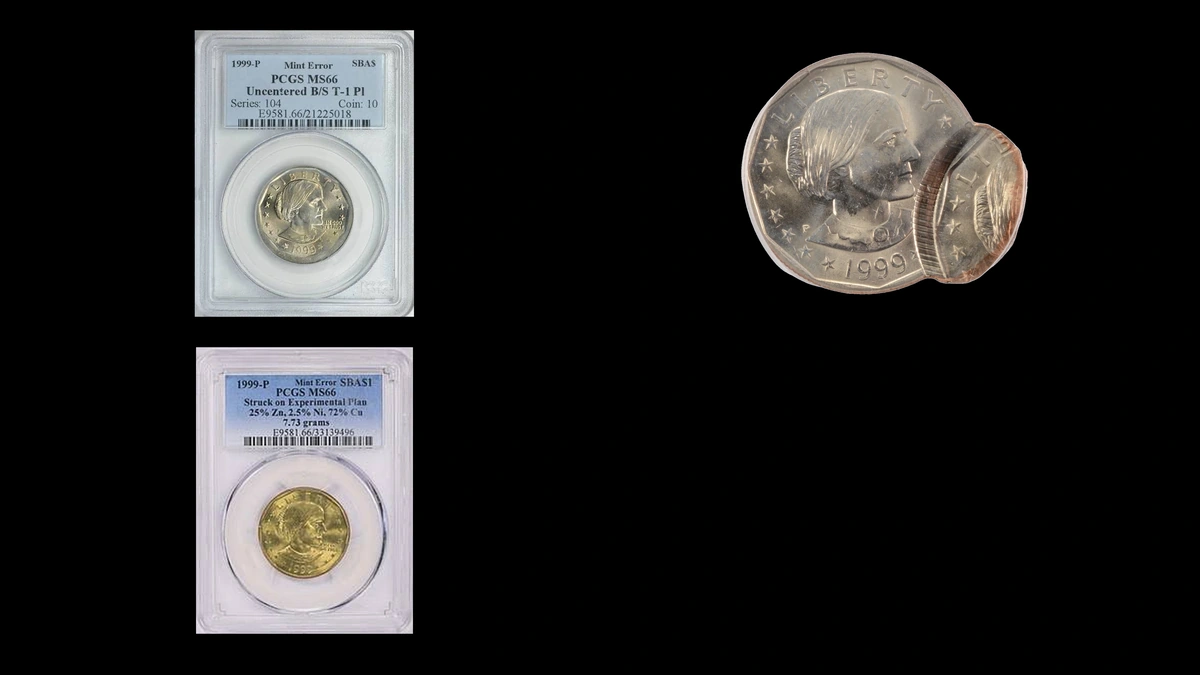
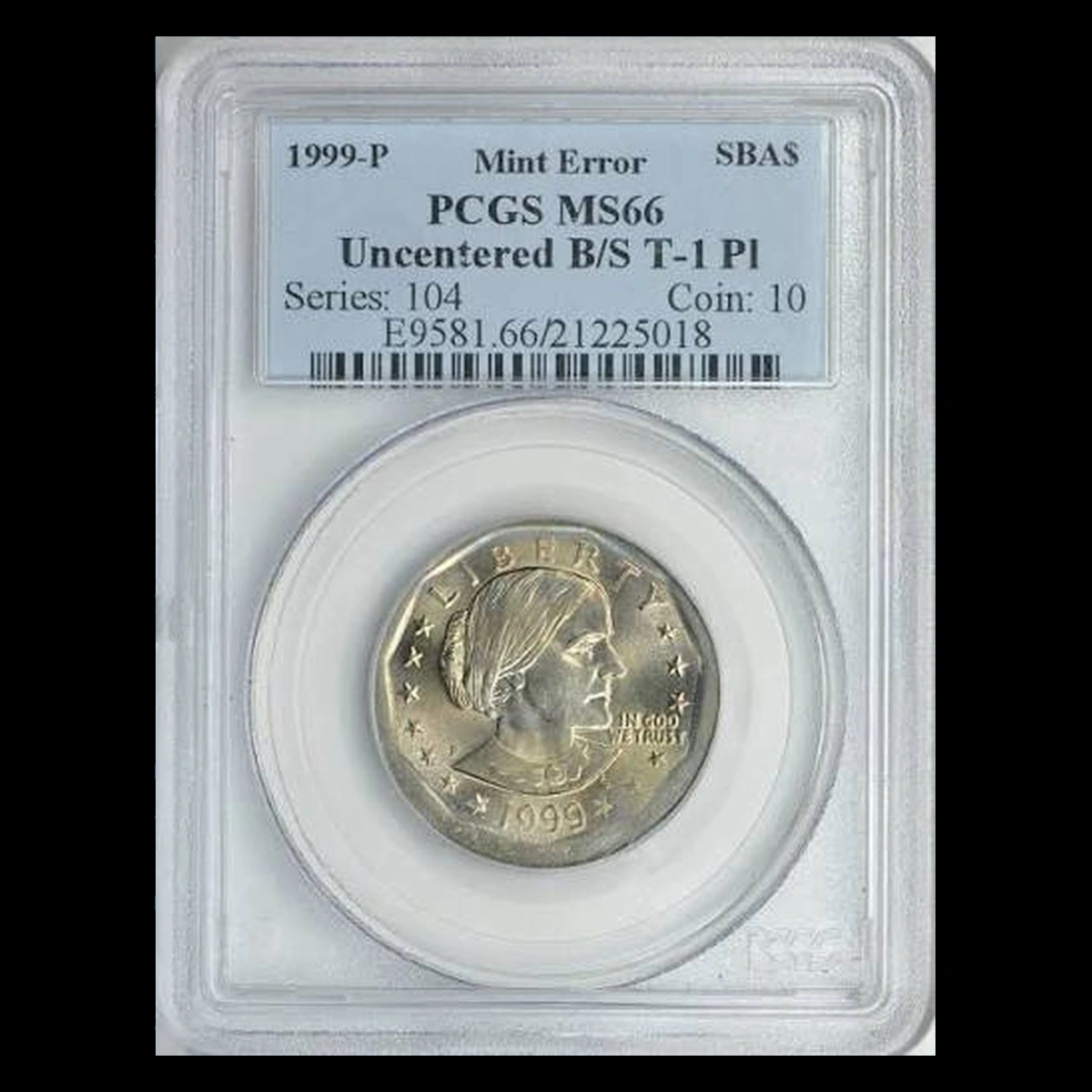
4. 1999 Dollar Incomplete Design or an Edge Contact: Off-Center and Chain Strikes Error
A Philadelphia example struck 75% off center retains only 199 from its date. Those digits identify 1999 within the Anthony series, which has no other 1990s issue.
A separate Philadelphia coin is 40% off center with a chain-strike edge, where another blank contacted it during the blow. That contact is an additional feature, not a requirement for every off-center coin.
How to Identify
Match untouched metal and incomplete design across both faces. Preserve the surviving Anthony design and date rather than identifying the issue from the blank area alone.
For chain contact, inspect the edge in side views and compare its boundary with adjacent struck surfaces. A later edge impact or a large blank crescent alone does not establish another blank’s contact.
What It’s Worth
$200–$3,500 is the estimated range for authenticated off-center examples. A 40% off-center Philadelphia MS64 sold for $432 in March 2023, and a separate 15% MS66 brought $234 in the same auction.
Neither sale, as supplied, proves chain contact on its coin. Keep the reported chain-strike specimen separate from those price comparisons.
5. 1999 Dollar Widely Separated Repeated Images: Double and Triple Strikes Error
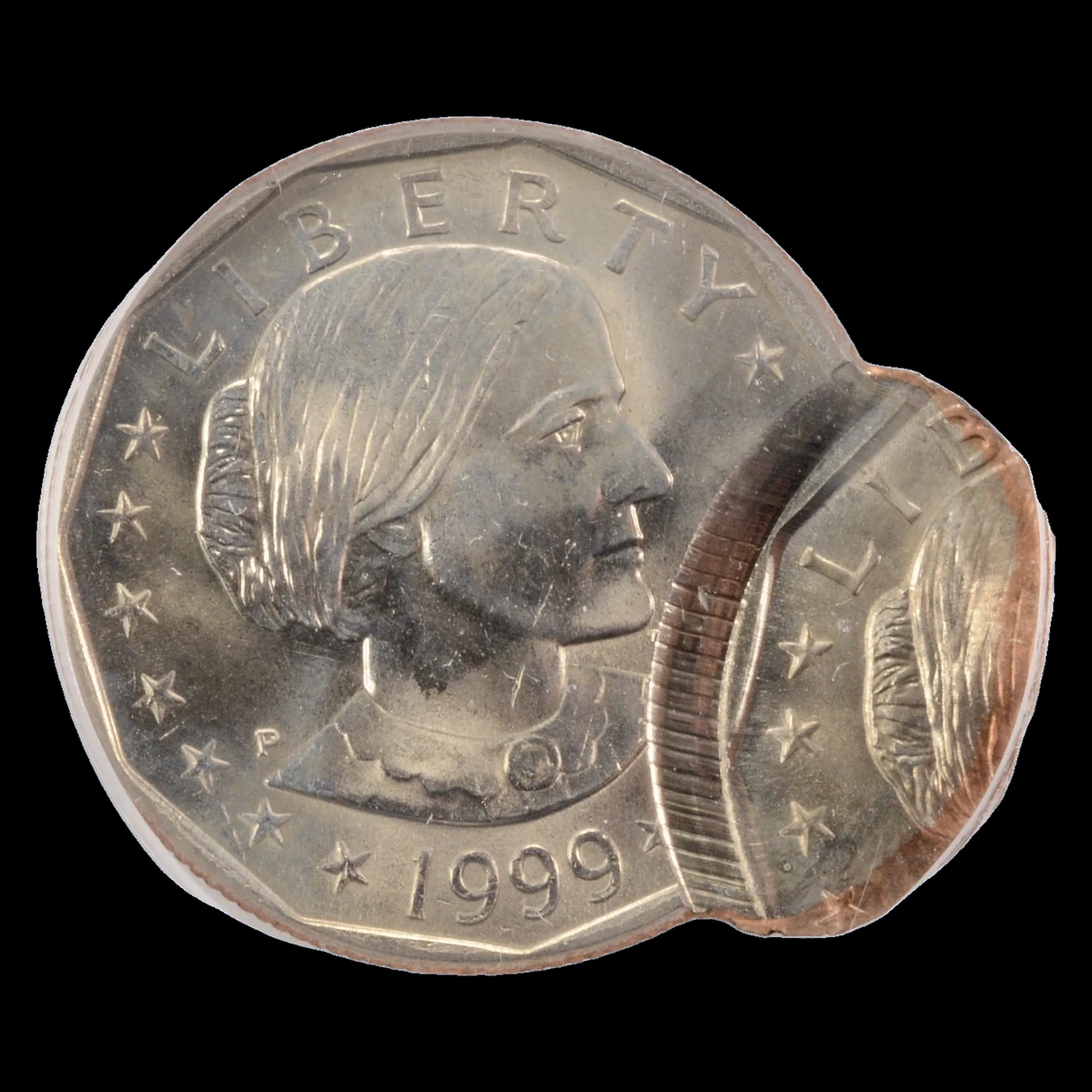
One Philadelphia double strike has its second impression 75% off center near 3 o’clock; another has an 80% second impression near 4 o’clock. Both had a blocked reverse during the second blow rather than a normal second reverse design.
A different Philadelphia triple strike has a second blow 25% off center. These examples document different coins, not successive photographs of one coin changing shape.
How to Identify
Trace distinct groups of portrait, date, or lettering detail and determine where the images cross. Then inspect the blocked reverse area instead of expecting a normal second design there.
For a triple strike, three blows need support from consistent surviving impressions. Several repeated edges within one shifted image do not establish several extra blows.
What It’s Worth
$500–$3,000 is the estimate for substantial authenticated double or triple strikes. Sullivan Numismatics offered the 75% second-strike ANACS MS66 example at $1,750.
That figure is a dealer’s asking price, not an auction result. Clear sequence and preservation matter more than multiplying value by the number of blows.
6. 1999 Dollar An Ordinary Strike on Prepared Metal: Proof-Blank Error
An ordinary die can strike a blank prepared for Proof production. The resulting coin is not automatically a Proof, because the blank preparation and the striking tools describe different parts of manufacture.
A documented Philadelphia example is broadstruck on a Type One Proof blank. Separate reports describe off-center strikes on Proof blanks.
How to Identify
Check that the professional description identifies an ordinary strike on a Proof blank, rather than merely labeling the coin Proof. Later polishing can imitate bright fields.
Compare the full design within expanded metal for the broadstrike, or missing design beside untouched metal for an off-center example. Weak finished rims alone cannot authenticate Type One preparation.
What It’s Worth
$750–$5,000 is the estimated range for a confirmed ordinary strike on a Proof blank with a substantial striking error. No exact sale is supplied for these examples.
The range values the complete combination. A shiny normal dollar does not qualify without evidence of the particular blank and strike.
7. 1999 Dollar Two Coins with Corresponding Contact Areas: Mated Brockage Pair Error
A documented Philadelphia pair consists of one double-struck coin and another with a partial brockage. The brockage is a backward, sunken transfer made when one coin’s raised design pressed into the other.
Both were graded ANACS MS64 and labeled as a matching pair. Their physical relationship is the important feature, not merely their shared date and grade.
How to Identify
Keep front, back, and edge photographs of each partner in separate sets. Match recognizable reversed details in the recessed impression to the raised design and contact area on the other coin.
The surfaces must explain how the pair met during striking. Do not confuse a stepped collar edge with a transferred image or press the coins together to test the fit.
What It’s Worth
$2,000–$6,000 is the estimated value for both authenticated coins together. Keeping the matching pair intact preserves the relationship collectors are buying.
One partner alone needs a different comparison. Two unrelated same-date errors do not become a mated pair because they are offered as a set.
8. 1999 Dollar A Wall Formed around the Die: Die Caps Error
A Philadelphia front-die cap was graded NGC MS67. The coin remained on its tool and changed shape through repeated contact as more blanks entered the press.
A separate PCGS MS65 coin combines broadstriking, multiple blows, and a reverse-die cap, followed by an exit strike about 80% off center. Its mint is not established by the supplied description.
How to Identify
Use side views to relate the wall to the surviving base design. The face against the tool and the face contacting later blanks can develop differently.
On the reverse cap, locate the additional exit impression separately from the earlier distortion. Later folds, plier marks, and forced bending can create a cup without demonstrating a die cap.
What It’s Worth
$1,000–$7,500 is the estimate for authenticated 1999 caps. Shape, preserved details, and visible striking sequence influence the comparison.
The multiple-struck reverse cap is one complex coin. Its broadstrike, cap, and exit strike are not separate prices to add together.
9. 1999 Dollar Golden Metal from a Mint Trial: Experimental Alloy Error
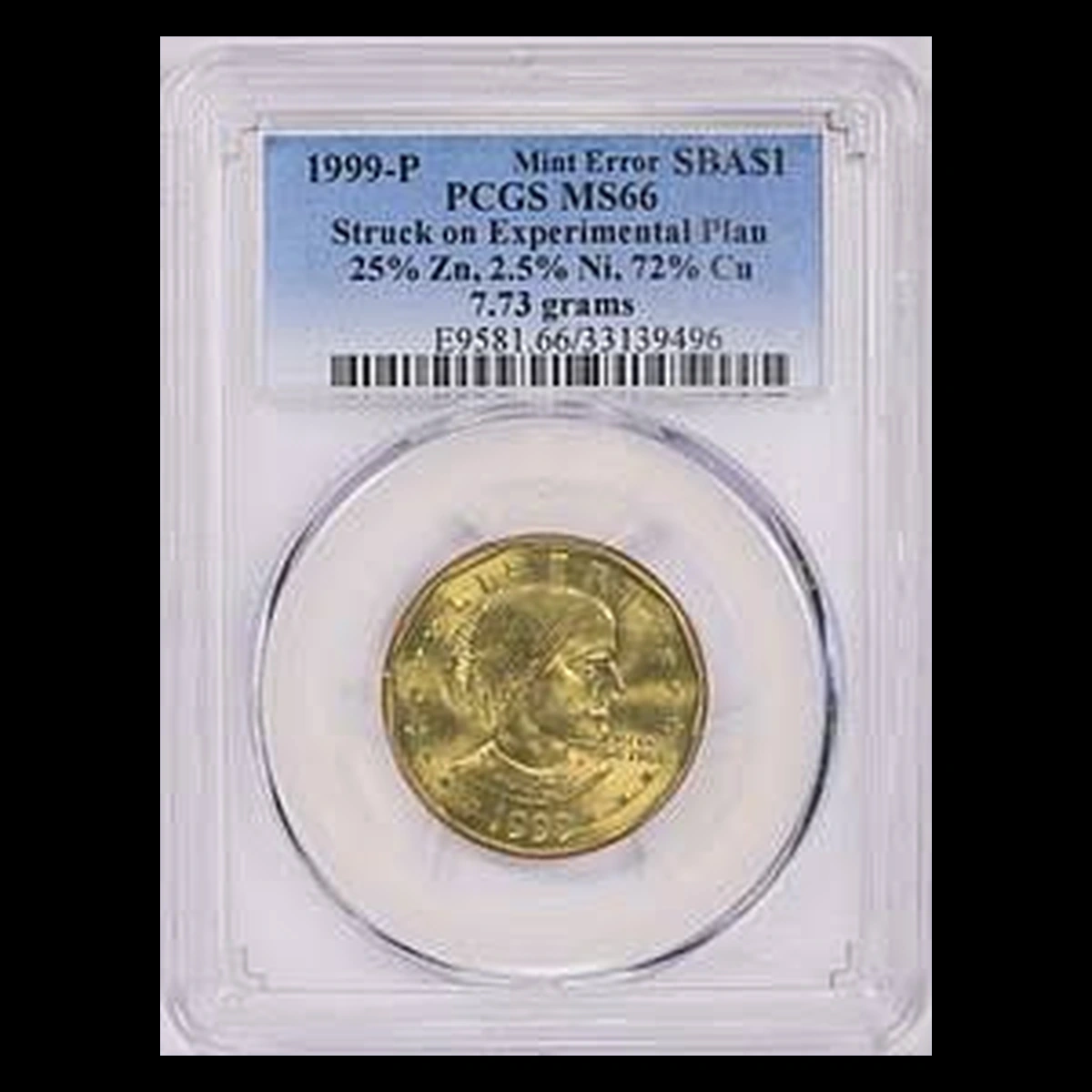
A 1999-P PCGS MS66 experimental piece contains 73% copper, 25% zinc, and 2% nickel. The Mint tested this unadopted alloy while developing the next dollar’s material.
This is distinct from the manganese-brass clad construction adopted for Sacagawea dollars. Its experimental purpose should not be rewritten as an accidental mix-up with production blanks.
How to Identify
Require professional composition evidence and an attribution identifying the experimental material. Photographs cannot establish percentages or distinguish the trial alloy from every golden-looking coating.
Keep the date and P visible and leave the surface untouched. Filing or scraping would damage the coin without resolving its documented history.
What It’s Worth
$8,000–$20,000 is the estimated range for a comparable authenticated experimental piece. The PCGS MS66 example sold for $10,575 in February 2013.
That unworn coin’s identified alloy and testing history are central. A plated souvenir and a dollar on a normal Sacagawea blank require different comparisons.
10. 1999 Dollar Anthony’s Design on Another Production Blank: Wrong Planchet Error
Philadelphia and Denver dollars are documented on golden Sacagawea blanks. The Denver NGC MS65 example weighs 8.1 g and has normal edge grooves, demonstrating why normal dollar weight cannot rule out this wrong-blank error.
Philadelphia strikes on cent and nickel blanks are also reported. Those smaller discs can leave much of the dollar design beyond the available metal.
How to Identify
Combine measurements with alloy, layering, and the natural struck boundary. The usual dollar is about 8.10 g and 26.5 mm; reference weights for cent and nickel blanks are 2.50 g and 5.00 g.
Those smaller-blank weights are standards, not measurements of specific 1999 candidates, and striking may expand their diameters. Examine reduced coins for filing and full-size golden coins for later plating before assigning a blank type.
What It’s Worth
$8,000–$25,000 is the estimated range for comparable authenticated Sacagawea-blank examples. A Philadelphia PCGS MS66 on that blank sold for $16,800 in January 2020.
Conditional estimates for the reported smaller blanks are $1,000–$5,000 for cents and $2,000–$10,000 for nickels. These are type estimates rather than invented sales of unnamed specimens.
Conclusion
The right 1999 Anthony comparison starts with a specific physical explanation. A trial alloy differs from a production blank mix-up, an incomplete design differs from a broadstrike, and a matched pair requires corresponding contact evidence.
Within the $50–$25,000 estimates, preserve each coin’s grade, identity, and combined features. The $16,800 result belongs to a Sacagawea-blank dollar, while the mated-pair range covers two authenticated partners together.