Rare 1954 Half Dollar Errors (List & Pictures)
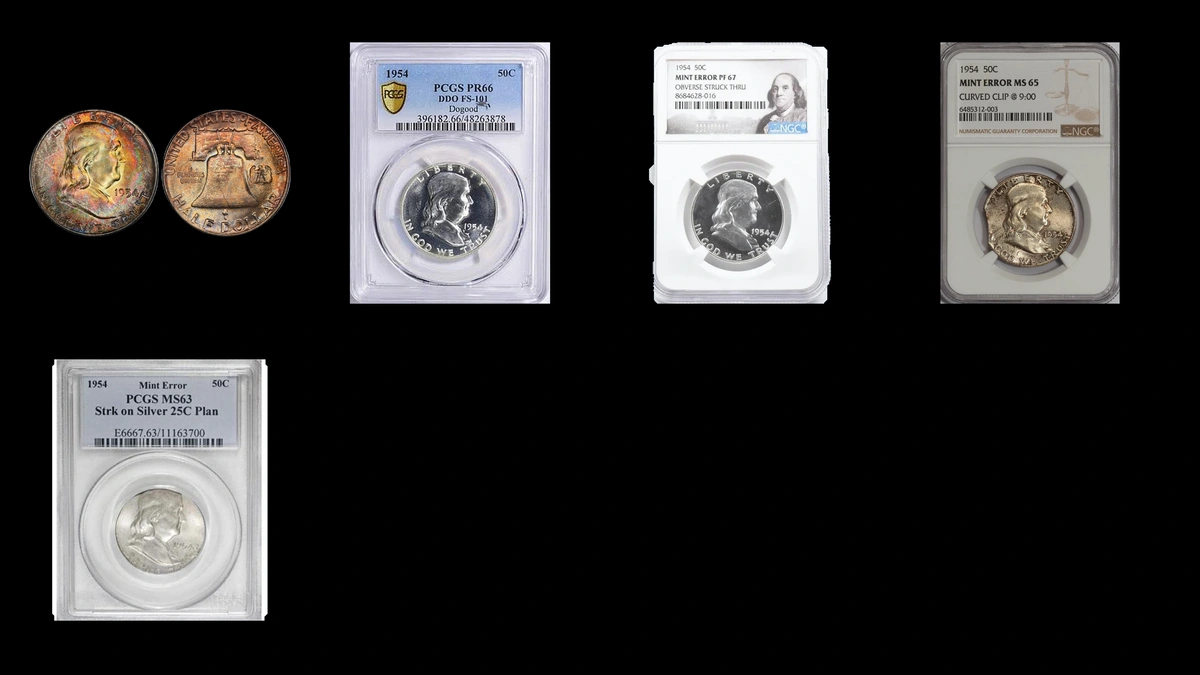
A tiny projection at Franklin’s lips can accompany a much higher price than its size suggests. An exceptional Bugs Bunny half dollar realized $9,600 in 2020, with superb preservation and Full Bell Lines contributing to the result.
Estimated values for 1954 half dollar errors span $50–$12,000, including smaller-blank coins with backward portraits. Inspect familiar design details first, then examine disturbed metal, the outline, and any reversed image.
| Clue | Error or variety | Estimated value |
|---|---|---|
| Toothlike mouth projection | Bugs Bunny and other clashes | $50–$9,600 |
| Extra contours on Proof lettering | Doubled die obverse | $400–$960 guide range |
| Another S contour | Reported repunched mintmark | $75–$750 |
| Reverse layer separating | Lamination | $50–$300 |
| Depressed interruption on reverse | Struck through | $75–$500 |
| Curved missing piece | Clip | $75–$400 |
| Opening through the metal | Reported planchet crack with brockage | $100–$1,500 |
| Design too large for the blank | Wrong planchet | $1,500–$12,000 |
| Sunken, reversed portrait | Brockage on smaller blanks | $3,000–$12,000 combined |
A normal 1954 half contains 90% silver, weighs 12.50 grams before wear, and measures about 30.6 millimeters across with a grooved edge. The ordinary crack drawn in the Liberty Bell is part of the design.
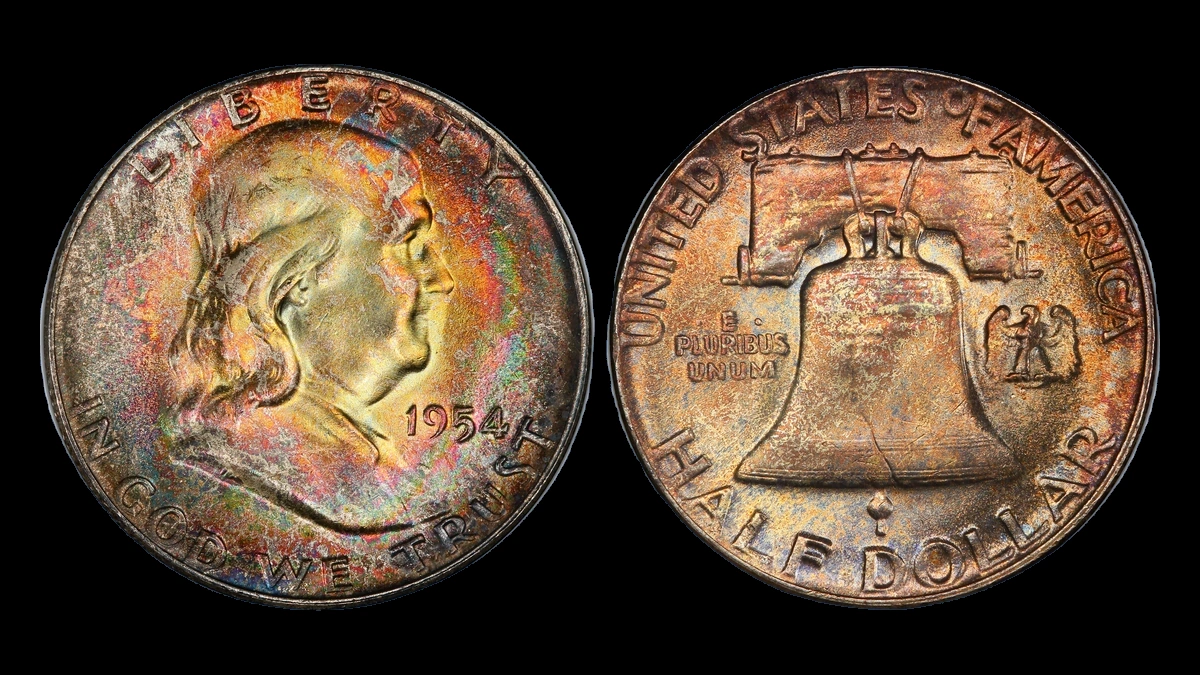
1. 1954 Half Dollar Franklin seems to show an extra tooth: Bugs Bunny and Other Die Clashes Error
The small mouth projection called Bugs Bunny originated when the dies touched without a blank between them. Part of the eagle’s wing marked the obverse die, which then reproduced an extra shape near Franklin’s lips.
Philadelphia and Denver examples are known, and a separate Philadelphia clash has other obverse traces. They require their own comparisons rather than one universal mouth test.
How to Identify
Identify the mint first: Philadelphia has no mintmark, while Denver has D above the bell. Compare the mouth shape with a recognized example from the same mint.
Inspect surrounding surfaces for damage that could push metal toward the lips. The actual projection should match the variety instead of being an arbitrary lump.
Full Bell Lines, abbreviated FBL, describes sharp complete lines at the bell’s base. It measures strike quality and does not establish an additional error or prove the mouth clash.
What It’s Worth
Ordinary collectible examples have an estimated $50–$750 range, while superior graded coins can reach $750–$9,600. Preservation and bell-line quality explain much of the difference.
The Philadelphia MS67 FBL auction record is $9,600 at Heritage in October 2020. A separate MS67 without FBL sold for $3,600 in August 2021, illustrating why the tiny projection does not have one fixed price.
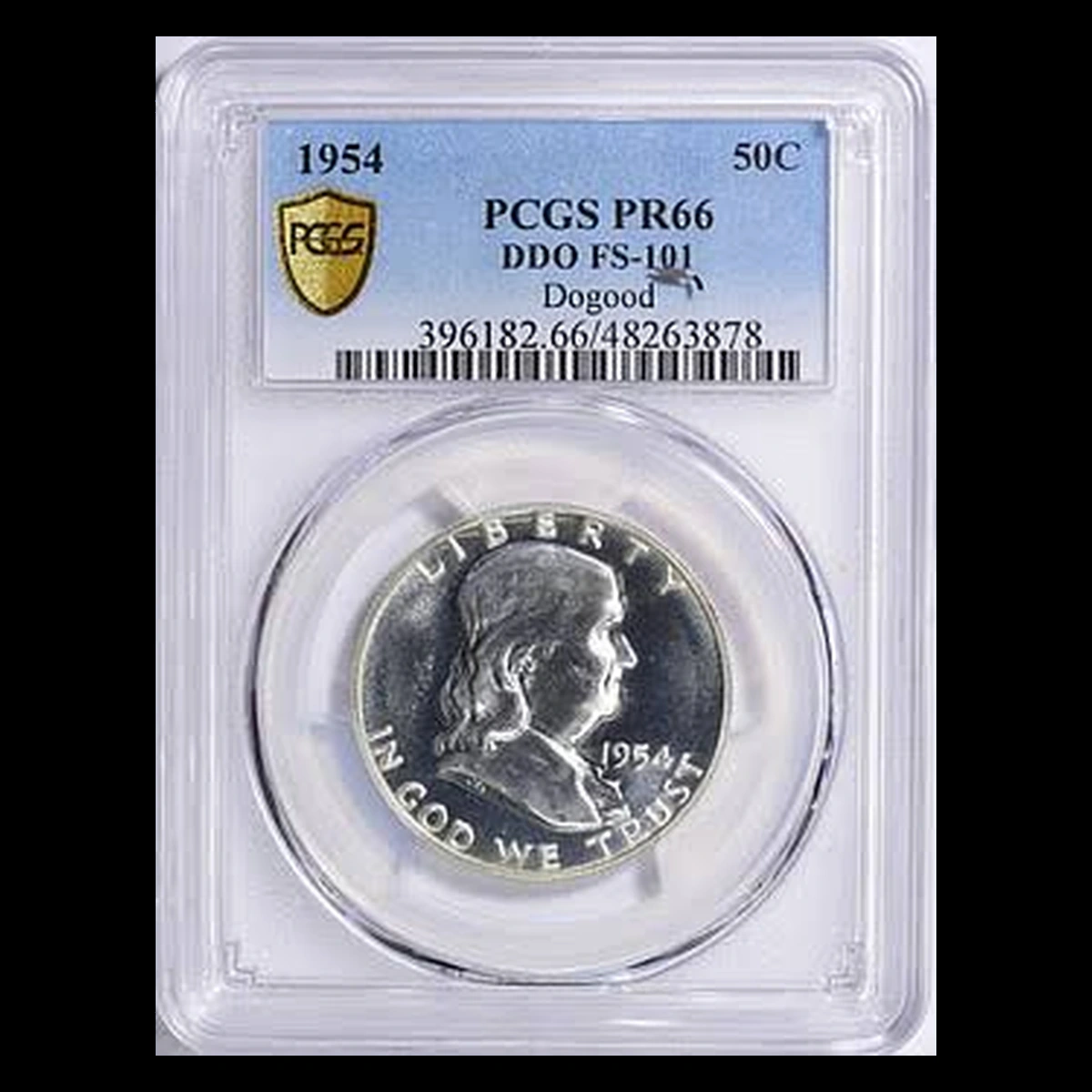
2. 1954 Half Dollar Proof lettering has fixed extra outlines: Doubled Die Obverse Error
The recognized FS-101 belongs to the 1954 Franklin Proof issue, specially made for collectors. Its duplicated detail was present in the die before striking, rather than being a reflection on a shiny coin.
LIBERTY and IN GOD WE TRUST are the important comparison areas. An unrelated coin carrying a similar variety label cannot supply the same diagnostic shapes.
How to Identify
Use magnification across the words while changing the light: a reflection moves, while an actual raised contour remains fixed. Check the full date and Proof finish as part of the identification.
The PCGS Proof 64 FS-101 listing provides a recognized example for comparison. Flat shelves from movement during striking should not be confused with its die-made detail.
Keep a graded Proof in its sealed holder. Wiping a reflective surface to improve visibility can damage the very areas used to judge it.
What It’s Worth
Greysheet’s quoted guide range is $400–$960 across its listed grades. PCGS separately records $7,950 for an NGC PF67 eBay Best Offer entry in April 2022.
The latter is a reported marketplace figure rather than a verified major-auction result or a promise for every high-grade example. No public realized amount from the cited Proof 64 listing is used here.
3. 1954 Half Dollar A second stroke appears beside S: Reported Repunched Mintmark Error
A collector described a PCGS MS65 1954-S as having a repunched mintmark. The report does not specify which direction the earlier S lies, and the numerical grade alone does not confirm the attribution.
Mintmarks were entered into dies with a hand punch. A shifted repeat could leave a recognizable remnant of the earlier letter beside the final S.
How to Identify
Above the bell’s wooden support, trace the extra contour to determine whether it forms part of another S. Compare with a normal 1954-S and a clear reference for the proposed repunched variety.
A shapeless bump or flat shelf is insufficient. Record the holder wording rather than assuming MS65 verifies an error, and do not borrow a direction from a different year.
What It’s Worth
A confirmed 1954-S repunched mintmark on a worn through ordinary unworn coin has an estimated $75–$750 range. No sale of the owner’s MS65 is supplied.
PCGS records $590 in May 2021 for a recognized 1952-S FS-501 in MS65. That different-year variety gives price context without confirming the proposed 1954 identification.
4. 1954 Half Dollar A reverse layer lifts from the silver: Lamination Error
The known dealer-offered 1954-D has a reverse lamination and PCGS AU58 grade. Its description does not specify exactly where the peeling occurs.
A weak bond inside the silver-copper mixture can let a thin layer lift or detach. This local separation should not be described as the entire coin splitting in two.
How to Identify
Leave loose silver in place and move shallow light across the boundary. A layer edge with depth differs from a smooth scrape or a flat discoloration.
Confirm the date and D above the bell, then inspect the edge for related separation. A very small lost layer may barely alter weight or diameter, so measurements cannot replace the surface evidence.
What It’s Worth
Estimated values are $50–$300 for modest original laminations on nearly unworn or ordinary unworn Franklin halves. The Harbor Coin listing identifies the 1954-D AU58 without a sale amount used here.
A different-year 1957 with obverse peeling, graded NGC MS63, sold for $74.49 including the buyer’s fee in January 2021. Its affected face and preservation remain distinct from the Denver reverse example.
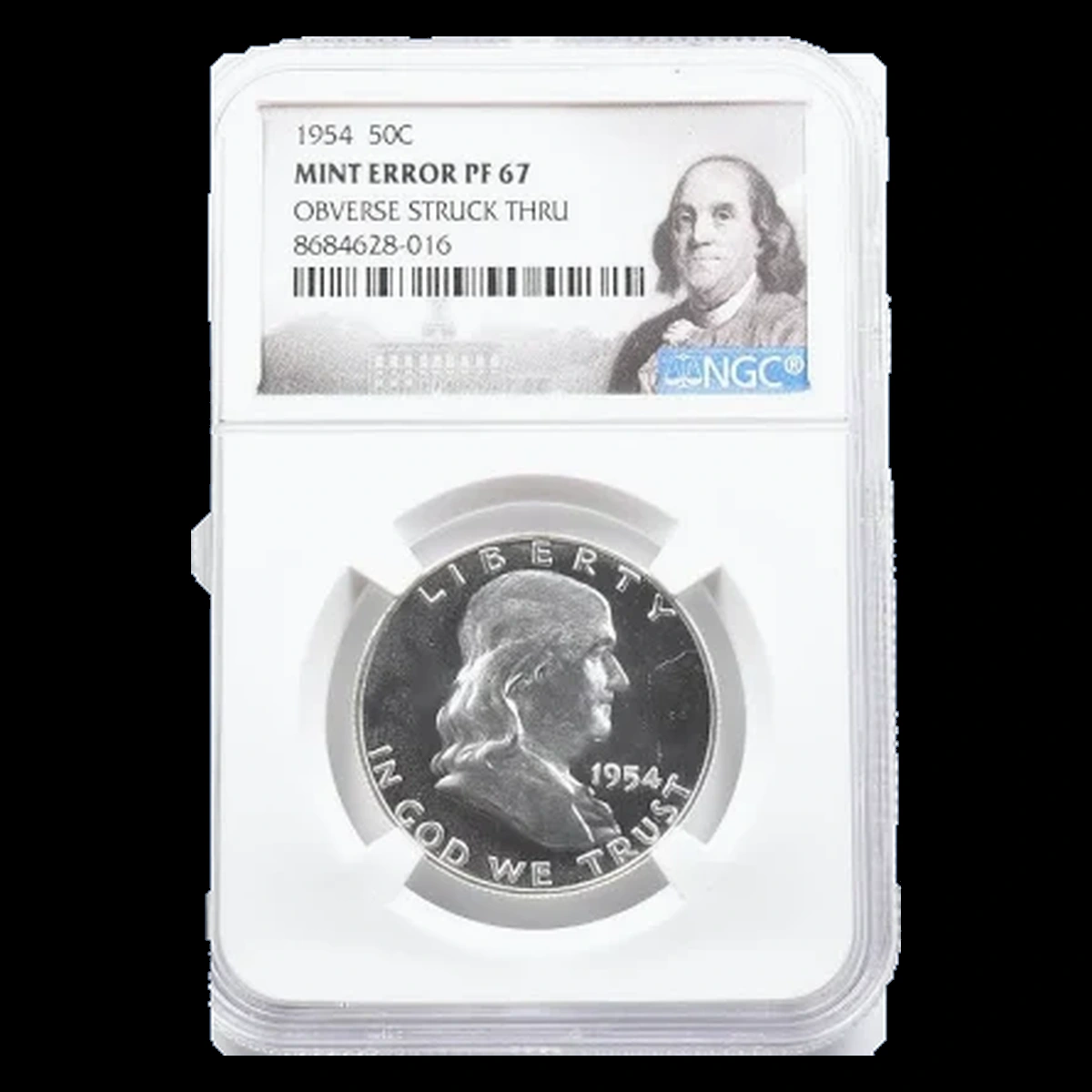
5. 1954 Half Dollar A depression interrupts reverse detail: Struck Through Error
An object caught between the reverse die and the blank can block part of the design or leave its shape in the metal. The 1954 report names the reverse but gives neither an exact position nor the material involved.
Calling the feature wire, cloth, or grease would therefore add an unsupported cause. The coin’s actual boundaries need to explain the interruption.
How to Identify
Examine where the depressed area meets normal struck detail under several light angles. A later impact may push metal into a raised lip, while a tool can leave cuts through the finished surface.
A generally weak strike can soften the bell without creating a distinct object impression. Confirm that the ordinary drawn bell crack is not being mistaken for the reported error.
What It’s Worth
The estimate is $75–$500 for a genuine visible strike-through on an ordinary collectible 1954 half. A clearly recognizable interruption can attract more interest than an indistinct hollow.
Greysheet reports $134 in April 2026 for a 1951-S NGC MS64 with an obverse strike-through. That different-year, different-face comparison does not price a retained object, which needs its own reference.
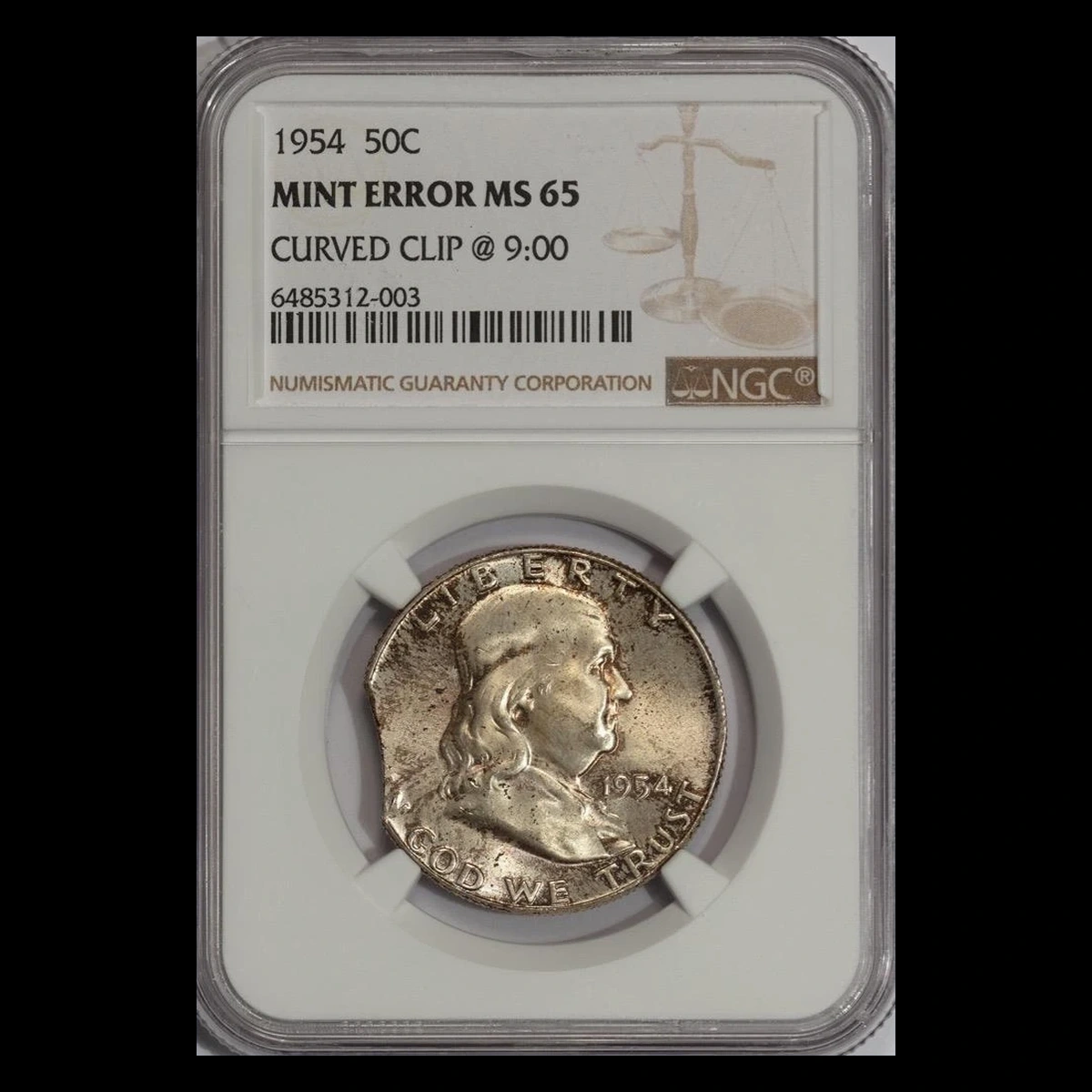
6. 1954 Half Dollar A curved gap interrupts the rim: Curved Clip Error
A blanking punch overlapping an earlier hole in the metal strip can cut an incomplete disc. When struck, that disc retains a curved missing section.
The year guide reports curved clipping without naming a certified specimen’s mint, finish, or location. It does not establish straight clips or several gaps on one 1954 coin.
How to Identify
Inspect both junctions where the gap meets the normal rim. Design and metal formed around an existing space differ from a sharp later cut slicing through finished details.
Look for tool marks and compare the lost weight with the absent portion. Weakness opposite the gap can support a clip but need not appear clearly on every example.
What It’s Worth
A genuine modest curved clip has an estimated $75–$400 range in worn through ordinary unworn condition. Size, preservation, and original edge evidence determine the comparison.
A 1962-D with a 4% clip in PCGS MS61 brought $84 in March 2011. That different-year Franklin provides a lower-range reference without establishing a 1954 sale or percentage.
7. 1954 Half Dollar An opening accompanies a backward image: Reported Planchet Crack with Brockage Error
The year list’s phrase “extreme brockage crack” suggests two features but identifies no specific specimen or crack route. One claim concerns an opening through the metal; the other concerns an impressed backward image.
A planchet crack lies in the coin blank itself. It differs from a raised line left when metal fills a fracture in the die.
How to Identify
Inspect the opening from both faces and the edge, looking for a natural split rather than a saw cut, shallow scratch, or raised ridge. Follow how the edge grooves meet the opening.
Examine the alleged brockage separately: it should be a recognizable design that is both sunken and mirrored. Later pressure between finished coins can imitate such an impression and may leave flattened rims or damaged surfaces.
The cent- and dime-blank brockages below are separate examples. Their reversed portraits do not establish cracks through their metal.
What It’s Worth
A genuine mint-made opening on a normal silver Franklin blank has an estimated $100–$600 range; a supported partial brockage with it raises the combined comparison to $500–$1,500. Both features must actually be present.
A 1952-D AU53 clamshell error had a $599 asking price. That hinged internal separation is a different type, and the offer is neither a completed sale nor proof of this reported combined error.
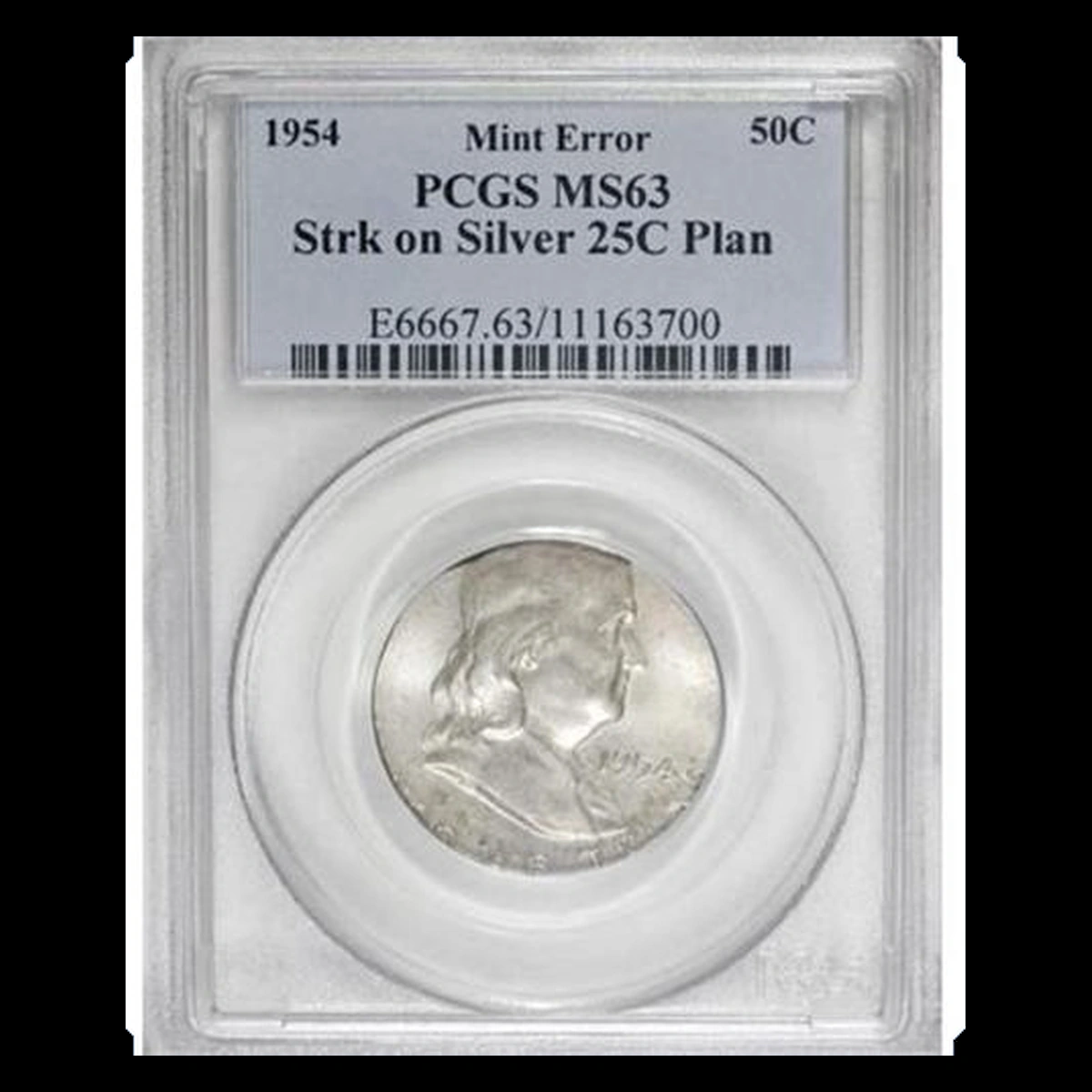
8. 1954 Half Dollar The half-dollar design is too large for the blank: Wrong Planchet Error
Three documented 1954 examples use smaller blanks: a silver quarter blank in PCGS MS63, a bronze cent blank in MS65 Brown, and a silver dime blank in MS62. The quarter example retains the full date and most of Franklin and the bell.
The cent and dime examples also have reverse brockages. These are blanks intended for other denominations, not previously struck cents or dimes overstruck by half-dollar dies.
How to Identify
Compare accessible weight and composition with the blank standards: 6.25 grams for a silver quarter, 3.11 grams for a bronze cent, and 2.50 grams for a silver dime. Those are standards, not supplied measurements of the individual illustrated coins.
Starting diameters are about 24.3, 19.05, and 17.9 millimeters respectively, and striking can spread the metal. Inspect the edge for grinding and check that the larger design ends naturally at the smaller blank’s boundary.
Record any surviving mintmark and examine the cent and dime coins’ reverse images separately. A wrong blank and a brockage describe different mechanisms on the same object.
What It’s Worth
Comparable quarter-blank examples have an estimated $1,500–$5,000 range; the cent- and dime-blank brockages have a combined $3,000–$12,000 estimate. Their two errors should not receive separate prices that are then added.
The silver-quarter MS63 sold for $1,610 in July 2009. No 2014 realized amount is assigned here to either smaller-blank brockage.
9. 1954 Half Dollar Franklin appears sunken and backward on the back: Reverse Brockage Error
A previously struck coin can remain between a new blank and a die. Its raised portrait then presses a recessed mirror image into the new coin instead of the intended reverse design.
Stack’s Bowers described this on the 1954 bronze-cent-blank coin and cataloged the silver-dime-blank example beside it. These are the same two compound errors discussed under wrong planchets.
How to Identify
Compare the recessed portrait with a mirrored normal Franklin image. Both the backward orientation and sunken relief must be present, rather than merely a second raised outline.
The 2014 cataloged pair provides the two small-blank examples. Check rims and surfaces for later damage because pressing completed coins together can imitate a reversed impression.
Use the appropriate cent or dime blank comparison from the preceding section. Full half-dollar edge grooves are not required on these much smaller pieces of metal.
What It’s Worth
The $3,000–$12,000 estimate values each genuine smaller-blank brockage as a complete compound-error coin. It repeats the previous comparison and is not an additional charge.
A 1982 dealer catalog offered a 1954 cent-blank full reverse brockage for $1,000. That historical asking price is not a completed sale or a result from the 2014 auction.
Conclusion
Some 1954 diagnostics are tiny, while others change the blank or replace the reverse with a mirrored portrait. Size alone does not explain value: preservation and attribution can make a small mouth clash unusually desirable.
Keep reported mintmarks and the unspecified crack-and-brockage claim at their proper evidence level. For the documented smaller-blank brockages, use one whole-coin comparison and inspect each of the two mechanisms independently.