Rare 1849 Dollar Errors (List & Pictures)
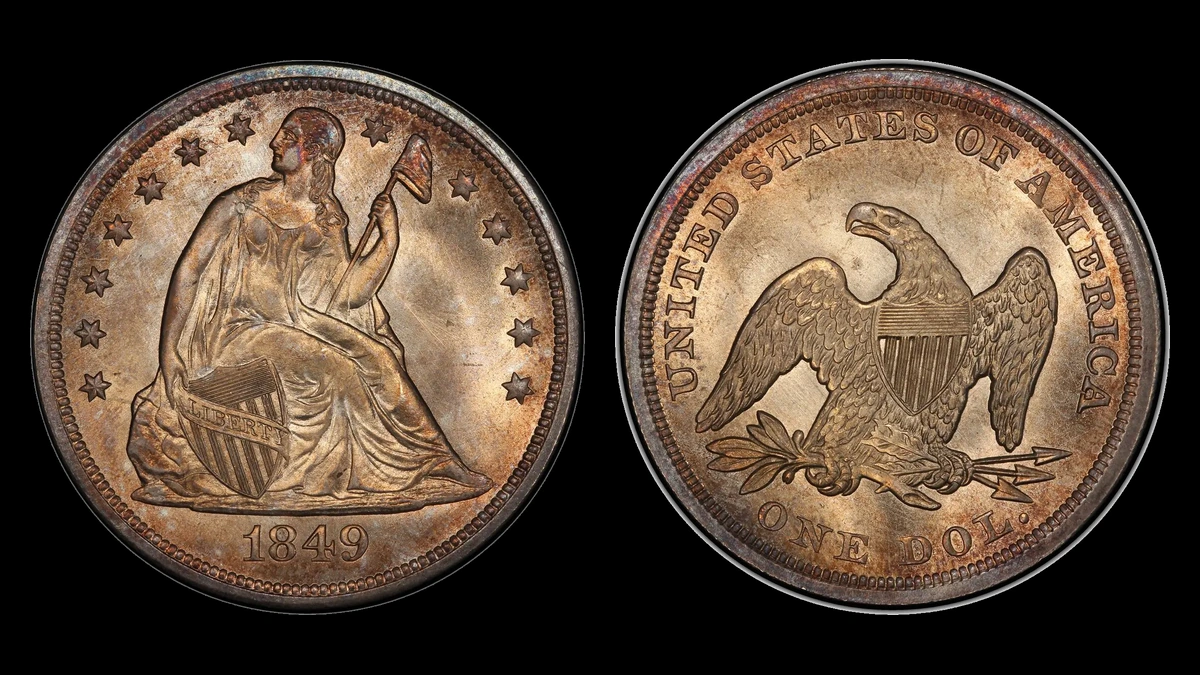
An ordinary 1849 dollar graded MS65 realized $41,400 in May 2003. The 1849 Liberty Seated dollar errors and die features below have estimated whole-coin values of $500–$45,000.
Inspect the short lines beneath Liberty’s chin with magnification, then test the reverse angle with a repeatable top-to-bottom flip.
1849 Dollar Short lines extend below the chin: die-finishing whiskers Error
A few fine downward lines can make Liberty appear to have whiskers. The reported marks came from finishing work on the die, the steel tool that stamped the portrait.
They are described on early impressions, before use changed the die’s appearance. Later coins can show the lines less clearly.
This is a small repeated tool feature on ordinary 1849 dollars. It is neither foreign material caught on the coin nor evidence that the portrait was intentionally given a beard.
How to Identify
Compare the area immediately below the chin with a clear early 1849 example. Keep the full date visible, since similar-looking marks can occur on other years.
Under a magnifier, follow the short lines downward while moving a lamp from the side. A matching tool pattern repeats its positions, whereas later scratches can cross the surface at unrelated angles.
Judge several lines together rather than elevating one faint scratch into an attribution. Do not rub the silver to brighten the detail.
What It’s Worth
The estimated whole-coin range is $500–$45,000 from worn through unusually well-preserved unworn examples.
PCGS records an ordinary MS65 at $41,400 in May 2003. That is preservation context, not a stated transaction for a whisker specimen.
The small lines can help describe the die’s condition. They do not independently set the dollar’s price or make a worn example comparable with an exceptional MS65.
1849 Dollar The eagle finishes slightly right of upright: rotated reverse Error
A few ordinary 1849 dollars are reported with roughly fifteen degrees of reverse rotation. The eagle leans slightly right after the front is aligned and flipped correctly.
The dies sat at different angles relative to their normal relationship. The whole reverse, including the surrounding words, turns together.
A modest lean can be exaggerated by tilted photography or a hand twisting during the flip. The reported angle is a comparison, not a measurement of every 1849 dollar.
How to Identify
Set Liberty upright against a vertical guide in a clear holder. Mark the holder’s top without marking the coin.
Turn it top to bottom around a horizontal axis and check whether the eagle stands upright. Repeat the motion if it leans, making sure the holder does not twist sideways.
Photograph both positions without independently rotating either image. Use a protractor or angle overlay to measure the repeatable deviation from vertical.
Keep the eagle and reverse wording visible so their shared orientation can be checked. Two separately straightened photographs cannot establish the angle between the faces.
What It’s Worth
Confirmed modest rotations are estimated at $500–$15,000 from worn through unworn coins with noticeable marks.
A different-year 1846-O rotated dollar graded XF40 sold for $780 in October 2024. That worn New Orleans coin is not a direct valuation of an 1849 Philadelphia example.
A fifteen-degree turn generally has less visual impact than a large rotation. Most of the whole-coin value can still come from the issue’s scarcity and the quality of its surfaces.
Conclusion
The chin feature and the reverse angle need different demonstrations. Use a close, well-lit comparison for repeated short lines and a fixed holder orientation for the eagle’s rightward lean.
Neither observation alone establishes an exceptional price. The $41,400 MS65 sale concerns general preservation, while the $780 rotation reference belongs to a different year and mint; compare the complete coin before applying either result.